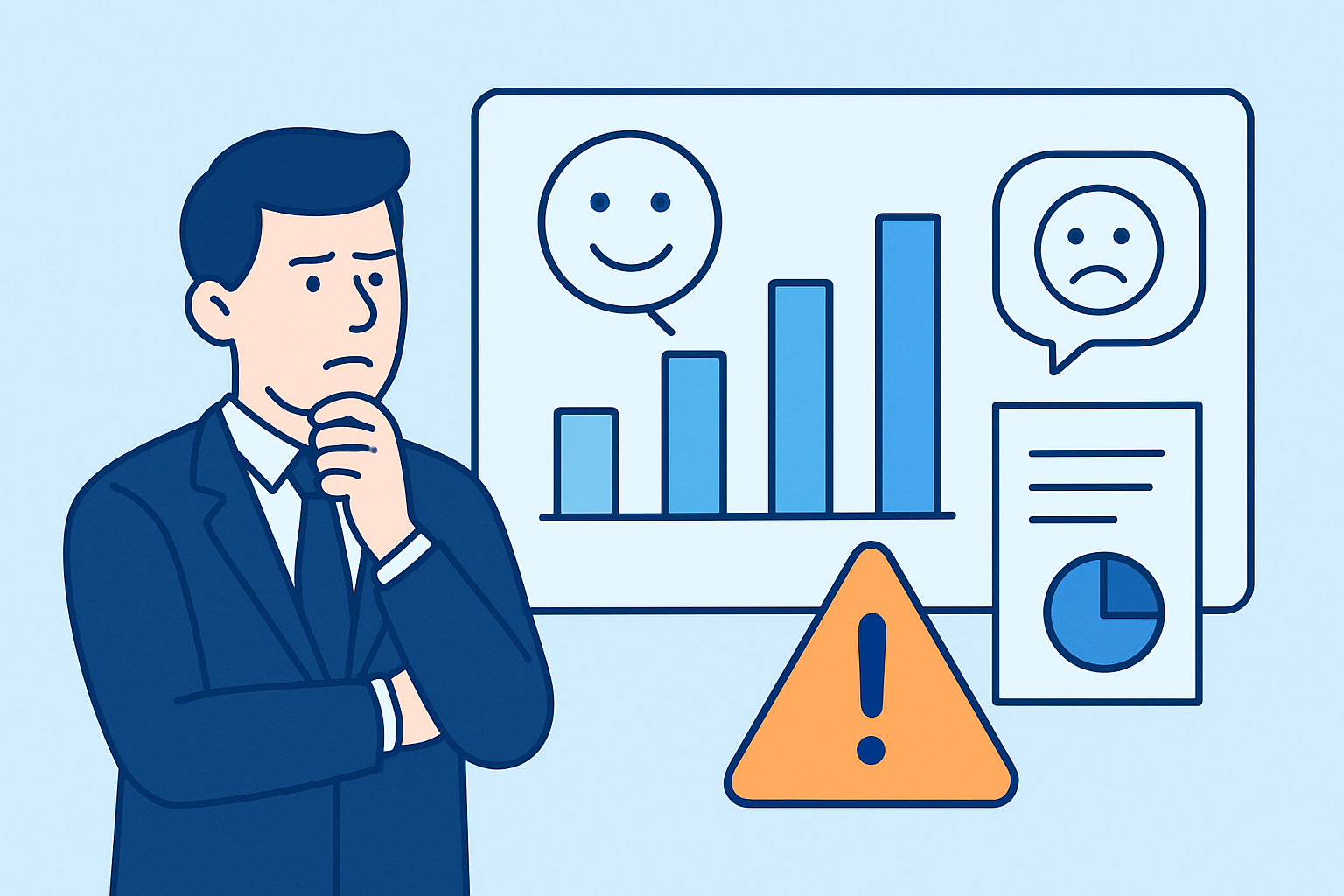
A brand manager checks the weekly sentiment dashboard and sees the score climb from 62 to 71 – a win worth mentioning in the Monday leadership sync, until someone reads the actual comments behind that number and finds three customers sarcastically praising a support team that ghosted them for two weeks. That gap between the score and the reality is exactly what sentiment analysis limitations are about, and it catches leadership teams off guard more often than most reputation tools like to admit. The number isn’t wrong, exactly. It’s just measuring something narrower than what people assume it measures.
What sentiment analysis actually measures
Most commercial sentiment tools – including the natural language processing models behind platforms like Brandwatch, Sprinklr, or the open-source VADER and TextBlob libraries – classify text into positive, negative, or neutral buckets based on word patterns, punctuation, and sometimes emoji use. VADER, for instance, was built and validated specifically on social media text from around 2014, scoring words against a lexicon of roughly 7,500 pre-rated terms.
That works reasonably well for a tweet that says “absolutely love this product, best purchase this year.” It works far worse for a Reddit thread where someone writes “sure, another ‘update’ that breaks the login page, great work team” – technically full of positive-sounding words, functionally a complaint. Sarcasm detection accuracy on these general-purpose models typically sits in the 60-75% range even on curated test sets, and real-world brand mentions are messier than test sets.
Why sarcasm and context break the scoring
Sarcasm isn’t the only blind spot. Industry jargon, regional slang, and mixed-language reviews all confuse models trained primarily on English-language, US-centric corpora. A Finnish or German customer writing in accented English, or switching languages mid-sentence, often gets scored as neutral simply because the model has low confidence – not because the sentiment was actually neutral.
Context length matters too. A three-word review (“it’s fine, whatever”) reads as neutral-to-positive to most classifiers, but a human reading the full review thread would recognize it as damning faint praise. Star ratings compound this: a 2019 Northwestern University study on Yelp data found meaningful mismatches between star rating and text sentiment in roughly 15-20% of reviews, usually because the reviewer rated the product fine but the service terrible, or vice versa, and the classifier averaged the two into something misleadingly middling.
The aggregation problem leaders don’t see
Even when individual sentiment scores are reasonably accurate, aggregating them into a single weekly or monthly number introduces a second layer of distortion. Ten mildly positive mentions and one furious, widely-shared complaint thread can produce the same average as eleven neutral mentions. The dashboard shows a flat line. The actual risk – one customer with 40,000 followers threatening to go public – doesn’t show up until it’s already trending.
This is the core reason reputation management metrics that actually matter tend to pair sentiment scores with volume, source authority, and reach, rather than reporting sentiment as a standalone health indicator. A single average number, presented without that context, is the single most common way sentiment data misleads a leadership team.
Common mistakes teams make with sentiment scores
An experienced brand strategist rarely trusts a sentiment score at face value before checking three things: sample size, source mix, and time window. A score based on 40 mentions this week versus 4,000 last month isn’t comparable, even though the dashboard plots them on the same trend line.
Three mistakes show up repeatedly in practice. Teams average sentiment across wildly different platforms – a Trustpilot review and a sarcastic tweet – as if they carry equal weight, when in reality a single-star Trustpilot review with detailed text tends to predict churn far better than a throwaway tweet. Teams also react to sentiment dips without reading the underlying mentions, sometimes issuing a public statement in response to what turns out to be five bot-generated spam comments rather than a genuine customer pattern. And teams set alert thresholds once and never revisit them, so a 5-point sentiment swing that was noise in a high-volume month gets flagged as a crisis in a low-volume month, or the reverse – a genuine problem stays under the radar because the threshold was calibrated during a noisy period.
Busting the “higher score means healthier brand” myth
The most persistent misconception is that a rising sentiment score straightforwardly means the brand is doing better. It doesn’t – not on its own. Sentiment scores measure tone, not substance, and tone can rise for reasons that have nothing to do with product or service quality: a viral meme unrelated to the brand’s actual offering, a PR-driven spike in positive but shallow mentions, or simply a quiet month with fewer detailed reviews pulling the average toward neutral-positive.
A genuinely healthier brand relationship shows up in repeat purchase rate, reduced support ticket volume, and review depth – customers writing more, not just more positively. Sentiment score is a useful early signal, not a verdict. Treating it as the verdict is how a 9-point weekly swing ends up in a board deck as a headline metric instead of a footnote worth investigating first.
How to use sentiment data responsibly
Sentiment tools stay useful as a triage layer, not a final answer. Set them to flag anomalies – sudden volume spikes, sharp score drops on high-authority sources like Trustpilot or G2 rather than low-authority ones – and route those flags to a human who reads the actual text before anyone reacts publicly. For teams reporting sentiment upward, pairing the raw score with two or three representative quotes gives executives the nuance a single number strips out; this is roughly the same discipline behind translating reputation scores into board-level reports that hold up under scrutiny.
Cross-referencing sentiment against how to measure brand sentiment across digital channels helps too, since sentiment on Reddit behaves very differently from sentiment on Google reviews or LinkedIn, and blending them into one number hides which channel actually needs attention.
Frequently asked questions
Can sentiment analysis reliably detect sarcasm?
Not consistently. General-purpose models catch obvious sarcasm cues like exaggerated punctuation but miss dry or understated sarcasm, which is common in professional B2B reviews and forum posts. Treat sarcasm-heavy sources, particularly Reddit and X, as requiring manual spot-checks rather than full automation.
Why does my sentiment score disagree with my star ratings?
Star ratings and text sentiment measure different things – overall satisfaction versus tone of the written comment – and they diverge in roughly one out of every five to seven reviews, usually when a customer separates product quality from service experience in the same review.
How often should sentiment thresholds be recalibrated?
Quarterly at minimum, and after any major volume change – a product launch, a viral moment, or a seasonal spike – since thresholds calibrated during low-volume periods produce false alarms once volume normalizes.
Sentiment scores are a compass, not a map. They point roughly toward where attention is needed, but the moment a leadership team starts treating the number itself as the story, the actual customer complaint sitting three clicks below the dashboard gets missed – and that complaint, not the score, is usually the one that turns into next quarter’s crisis.