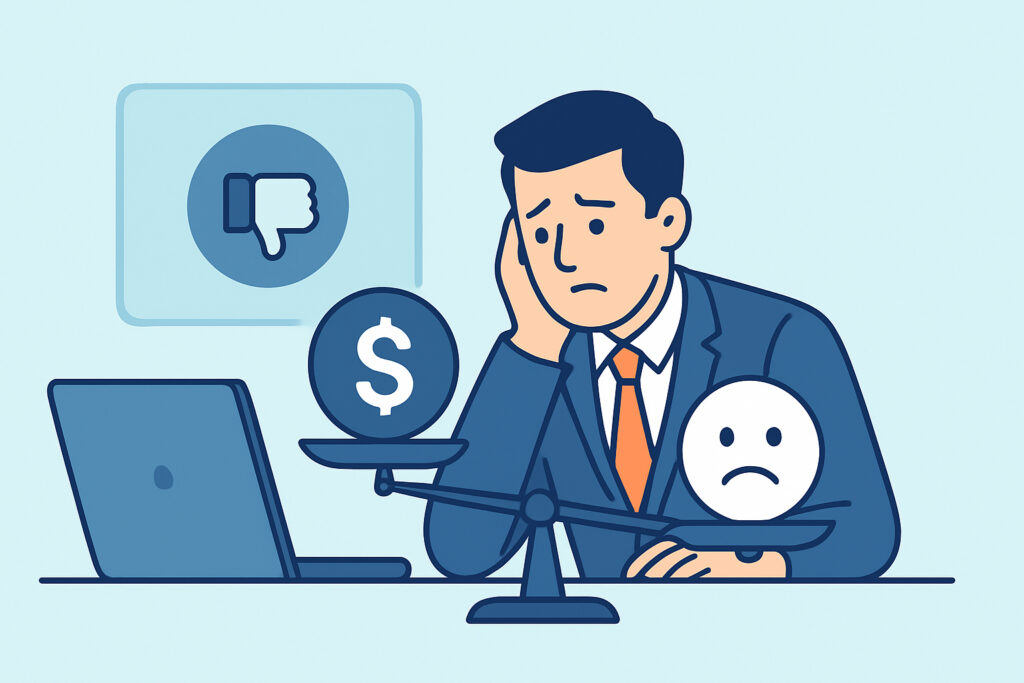
Every brand manager has sat through a budget meeting where reputation monitoring gets cut because it’s hard to point to a line item it protects. Reputation ROI is the exercise of putting a number on what inaction actually costs – lost deals, higher acquisition spend, and slower recovery when something goes wrong – so that the investment stops looking like a soft expense and starts looking like risk management with a price tag.
The problem is that reputation damage rarely shows up as a single dramatic event on the P&L. It shows up as a slow erosion: conversion rates that drift down a few tenths of a percent, sales cycles that stretch out because prospects found a bad review during due diligence, or a customer service backlog that quietly convinces people to churn. None of that triggers an alarm the way a server outage does, which is exactly why it survives budget cuts year after year.
Why “doing nothing” is never actually free
Doing nothing doesn’t mean nothing happens – it means nobody is watching while it happens. A one-star review sits unanswered for three weeks. A Reddit thread accumulates forty replies before anyone from the company sees it. A competitor starts outranking you on branded search terms because your content has gone stale. Each of these has a cost, it’s just deferred and distributed across departments that don’t talk to each other.
A useful mental model: reputation problems compound like interest, but in reverse. An unanswered complaint doesn’t stay one unanswered complaint. It gets screenshotted, referenced in other reviews, and cited by prospects who found it during a Google search before ever reaching a sales call. The cost of fixing it later is always higher than the cost of catching it early, and that gap is the real ROI case.
Building a rough cost-of-inaction model
You don’t need a finance team to build a directionally useful model. Start with three inputs that most companies already have:
Customer acquisition cost. If it costs 150 euros to acquire a customer through paid channels, every prospect who bounces off a bad review before converting is a direct loss against that spend.
Average deal size and sales cycle length. B2B companies especially underestimate this – a single negative G2 or Capterra review referenced during a competitive evaluation can extend a sales cycle by weeks or kill a deal outright.
Churn and support cost. Reputation issues that stem from real product or service gaps tend to show up in both new-customer conversion and existing-customer churn simultaneously, doubling the impact.
Multiply the estimated percentage of prospects or customers affected by each of these figures over a quarter, and the “do nothing” cost usually turns out to be a five- or six-figure number even for mid-sized businesses. That’s the number worth putting next to the cost of active monitoring.
The metrics that actually move the needle
Not every number is worth tracking, and chasing vanity metrics is one of the most common mistakes in this space. Review volume alone means very little without sentiment trend attached to it. Star rating alone hides whether the trajectory is improving or declining. The metrics that correlate with revenue tend to be: sentiment trend over time, response time to negative feedback, and the ratio of resolved versus unresolved complaints across the platforms that matter for a given industry. A deeper breakdown of which numbers actually correlate with business outcomes is covered in Reputation Management Metrics That Actually Matter, which is worth reviewing before building a dashboard nobody looks at.
A common misconception worth busting
Many teams assume reputation only matters at the extremes – either a full-blown PR crisis or a five-star glow. In practice, the businesses that lose the most money are the ones sitting in the quiet middle: a 3.8-star average that nobody is actively improving, or a steady trickle of unanswered complaints that never becomes newsworthy but slowly convinces price-sensitive buyers to go elsewhere. Crisis response gets the attention and the budget; the slow bleed gets ignored because it never produces a single moment that demands action. That slow bleed is usually the larger cost over a 12-month period.
What early detection actually saves
The financial argument for monitoring isn’t abstract – it’s the difference between catching a problem at ten mentions versus a thousand. A negative pattern caught within hours can be addressed with a direct response and a fix before it reaches review aggregators or search results. The same pattern caught after a month has usually already been indexed, screenshotted, and referenced elsewhere, at which point the cost shifts from “respond and resolve” to “manage ongoing damage,” which is a fundamentally more expensive category of work. The broader financial relationship between reputation health and top-line growth is explored further in The Connection Between Online Reputation and Revenue Growth.
Putting a number on the downside
For a concrete estimate, businesses can walk through the cost categories laid out in The Hidden Costs of Poor Online Reputation for Businesses, which breaks down where reputation damage actually hits the balance sheet – recruitment, financing terms, customer lifetime value, and search visibility among them. Running through even a simplified version of that exercise once a year is usually enough to reframe monitoring from a cost center to a form of insurance.
Frequently asked questions
How do you calculate reputation ROI without a dedicated finance team?
Start with three known numbers – customer acquisition cost, average deal size, and estimated churn rate – then apply a conservative percentage impact based on review sentiment trends. Even a rough model, revisited quarterly, is more useful than no model at all.
Is reputation ROI only relevant during a crisis?
No. The largest cumulative losses tend to come from steady, low-grade reputation erosion rather than single dramatic incidents, since erosion rarely triggers the internal alarms that a crisis does.
How often should reputation data be reviewed to catch problems early?
Daily or hourly review cycles catch emerging patterns while they’re still small and manageable; monthly or quarterly reviews tend to catch problems only after they’ve already become expensive to fix.
The real takeaway is that “doing nothing” is a decision with a cost, even when nobody signs off on it. Treating reputation monitoring as a measurable input – with real numbers attached to acquisition cost, deal size, and response time – turns an abstract argument into one that survives a budget meeting.