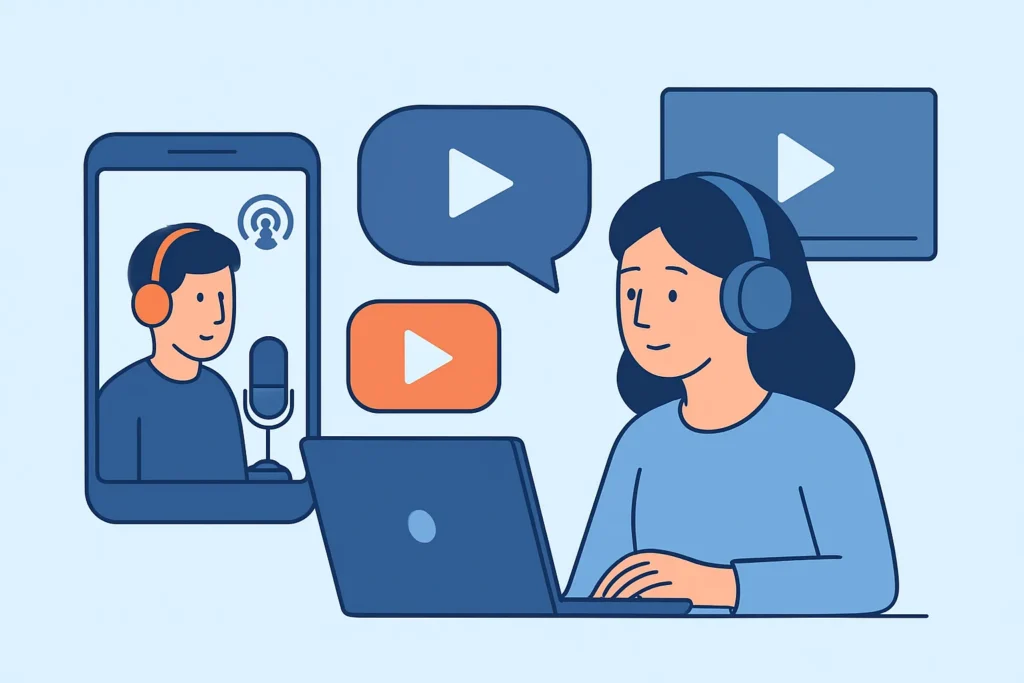
Podcast and video mentions are where many brands now get discussed most candidly, and they’re also where standard text-based monitoring stops working. If you run a brand or a reputation program, the things being said about you on a 90-minute podcast, a YouTube review or a live stream can reach tens of thousands of listeners before a single written word about them shows up anywhere. This article covers why these mentions slip past keyword tools, how to capture them reliably, and what to do once you find them.
Why Spoken Mentions Escape Keyword Alerts
Most online reputation monitoring is built on indexed text: news articles, review pages, social posts, forum threads. A keyword alert fires when your brand name appears as a string of characters. Audio and video don’t contain strings. They contain sound waves and pixels.
A podcast episode’s title and show notes might never mention your company, even when a guest spends 12 minutes describing a bad experience with your product. A YouTube video might show your logo on a box for 40 seconds with no spoken name at all. Text monitoring sees nothing in either case.
The gap grows wider when a clip gets cut and reposted. A host’s offhand comment can become a 30-second vertical clip on TikTok, Instagram Reels and YouTube Shorts within 48 hours, often with captions burned into the video as images, which keyword search can’t read. The dynamics of that kind of spread are covered in more detail in TikTok mentions monitoring when virality hits.
A Common Myth About Transcripts
Many marketers believe that transcripts have solved the problem. YouTube auto-generates captions, Apple Podcasts added automatic transcripts in iOS 17.4 in 2024, and Spotify has rolled out transcripts for many shows. So surely everything spoken is now searchable?
Not really. Most of these transcripts live inside each platform’s app and aren’t exposed to general web search or to the APIs monitoring tools rely on. And automatic speech recognition struggles with brand names in particular. A SaaS product called “Qlik” turns into “click.” A Finnish brand name spoken by an American host comes out as three unrelated English words. Invented spellings, acronyms and names that sound like everyday words get mangled most often.
An experienced reputation analyst assumes the transcript is wrong for proper nouns and builds a list of likely mishearings to search alongside the real name.
A Realistic Scenario
Picture a mid-sized meal-kit company. Review scores on Trustpilot and Google sit steady at 4.3, brand sentiment on X looks neutral, and nothing unusual shows up in news monitoring. Then customer support sees cancellations rise about 15% over three weeks, and several customers say “I heard about the packaging thing.”
Eventually the trail leads to a mid-tier parenting podcast with around 25,000 downloads per episode. A host spent eight minutes on a story about a delivery left in the heat. The episode title was about summer routines. The brand name came up only in speech, and the auto-transcript spelled it wrong. By the time the team found it, the clip had been shared in two large Facebook parenting groups.
The lesson isn’t that the podcast was hostile. The team simply had no visibility into a channel their target customers trusted more than reviews.
How to Monitor Podcast and Video Mentions Step by Step
The benefit is simple: you hear criticism while it’s still one episode, not a narrative. Here’s a workable process for a small team.
Step 1 – Map the shows that matter. Find the 20-50 podcasts and YouTube channels your customers actually follow. Customer surveys, Listen Notes, Podchaser and YouTube search in your category will get you there faster than generic “top podcasts” lists.
Step 2 – Pull transcripts where they exist. Many shows using the Podcasting 2.0 namespace publish transcripts through the podcast:transcript RSS tag. For YouTube, captions can be retrieved for most public videos. Where nothing is published, run audio through an open-source speech model such as OpenAI’s Whisper, which works well on a standard laptop for a few episodes per week.
Step 3 – Build a phonetic keyword list. Include your brand, product names, executive names and their likely misspellings. Test it by running a known mention through the transcription tool and noting how the name comes out.
Step 4 – Watch for visual mentions. Logo detection services like Google Cloud Vision can flag brand imagery in video frames. For most teams under 10 people this is overkill. Instead, check the top 10 review and unboxing channels in your niche by hand once a month.
Step 5 – Connect audio findings to text signals. A podcast mention often shows up first as an indirect text signal: a Reddit thread saying “heard on a podcast,” a spike in branded search, or support tickets with unusual wording. Good media monitoring for brands treats these as leads pointing to an audio source.
Common Mistakes to Avoid
The first mistake is monitoring only titles and descriptions. Podcast metadata is written for discovery, not accuracy. Teams that track only episode titles catch maybe a fraction of real mentions, and usually only the planned, sponsored ones.
The second is treating every mention as equally urgent. A one-line joke on a show with 800 listeners isn’t a crisis. A detailed complaint on a show your sales prospects listen to every week might be. Set thresholds around audience fit and how long the mention lasts, not raw counts, or the team will start ignoring alerts within a month. Setting alert thresholds that avoid notification fatigue goes into this in more depth.
The third is responding in the wrong channel. Posting a corporate reply under a YouTube video often draws more attention to it. A polite email to the host with facts, and an offer to come on the show, tends to work better. Many hosts will add a correction to the show notes or mention it in the next episode.
Edge Cases and Exceptions
Non-English markets need special care. Speech recognition accuracy drops sharply for smaller languages and regional dialects, and it drops again for code-switching, such as Finnish speakers mixing in English product terms. If your key market speaks one of these languages, budget for human review of flagged episodes.
Regulated industries have their own limits. Healthcare, financial services and pharma companies often can’t respond publicly to specific claims about a patient or client, even if they’re false. For them, podcast monitoring is mostly about early warning and preparing legal and communications teams, not about replying.
B2B companies with long sales cycles should weight niche industry podcasts heavily. A single episode of a respected trade show heard by 3,000 procurement leads can move more pipeline than a viral consumer video.
FAQ
Can podcast and video mentions be tracked automatically?
Partly. Transcripts and speech-to-text tools can make spoken mentions searchable, but accuracy on brand names varies. Plan for automation that surfaces candidate mentions, plus a quick human check before anyone acts.
How often should podcast content be checked?
For most brands, a weekly scan of priority shows is enough. During a product launch, recall or active crisis, switch to daily checks, because clips can spread across short-video platforms within 1-2 days.
Should a brand respond to criticism on a podcast?
Only when the claim is factually wrong or the audience overlaps heavily with your customers. Reach out privately to the host first. A public reply is a last resort.
Summary
Spoken and visual mentions are a real blind spot in reputation management because keyword tools only read text. Closing that gap takes a defined list of priority shows, transcripts you check for brand-name errors, a phonetic keyword list, and the habit of tracing indirect text signals back to their audio source. Start small: pick 20 shows this week, transcribe the last three episodes of each, and see what your current monitoring has been missing.