If you run a business in 2026, your brand’s digital footprint is shaping customer decisions long before anyone contacts your sales team. Learning how to analyze your brand’s digital footprint effectively isn’t optional anymore — it’s the foundation of smart reputation management. Whether you’re a brand manager at a mid-sized company or a business owner wearing too many hats, understanding exactly where and how your brand appears online gives you control over a narrative that’s otherwise written by strangers.
The problem? Most businesses only discover their digital footprint when something goes wrong. A negative review trend, a blacklisted IP address quietly killing email deliverability, or a competitor quietly outranking you for your own brand name. By then, you’re already playing catch-up.
This guide walks you through a practical, repeatable process for mapping, measuring, and acting on your brand’s entire digital presence.
What Exactly Is a Digital Footprint?
Your brand’s digital footprint is the sum of every trace your business leaves online. That includes the obvious things — your website, social media profiles, and blog posts — but also the less visible signals: customer reviews on Trustpilot and Google, mentions on Reddit threads, DNS records, email authentication settings, blacklist status, and even whether someone has registered a typosquatted version of your domain.
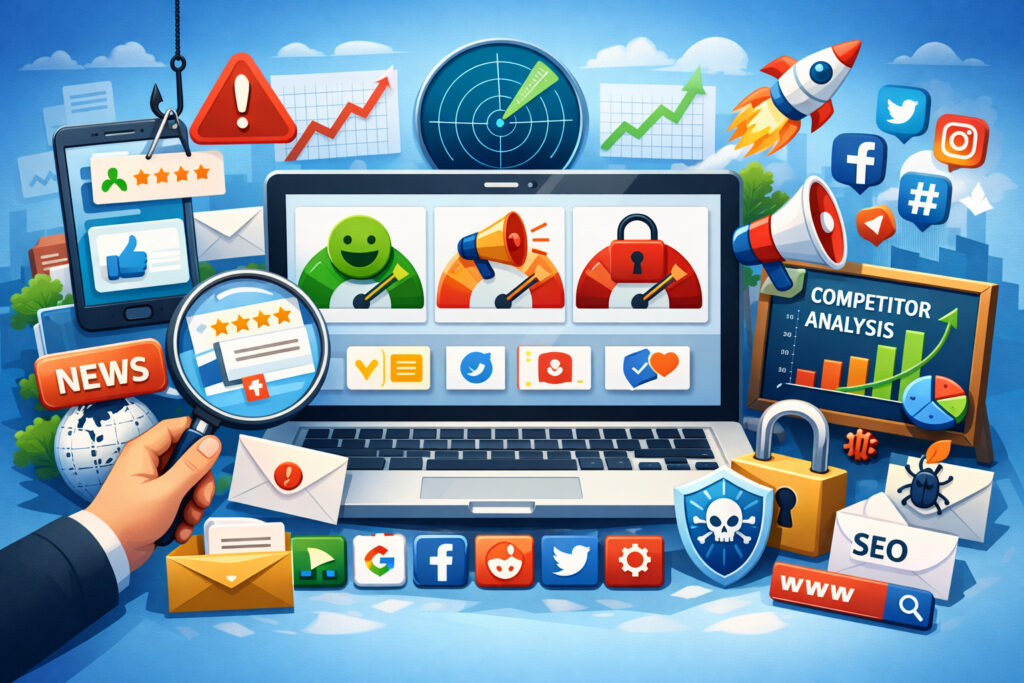
Most businesses dramatically underestimate the size of their footprint. They think of it as “our website and our social accounts.” In reality, it spans three distinct layers: online reputation (reviews, media mentions, employer brand), brand and marketing presence (sentiment, visibility, competitor positioning), and technical security (email deliverability, blacklists, phishing risks, domain integrity).
Ignoring any one of these layers creates blind spots that competitors and bad actors are happy to exploit.
Step 1: Audit Your Review and Mention Landscape
Start with what customers actually see. Search your brand name on Google, then check every major review platform individually — Trustpilot, Google Business, Facebook, Yelp, G2, Capterra, and Reddit. Don’t just glance at star ratings. Read the most recent 20–30 reviews on each platform and note recurring themes.
I’ve seen businesses with a solid 4.3-star average on Google completely blindsided by a pattern of negative Trustpilot reviews about shipping delays — reviews they never saw because nobody was monitoring that platform. By the time they noticed, the Trustpilot page was outranking their own website for branded search terms.
Document what you find: which platforms have profiles (even ones you didn’t create), your current ratings, review volume trends, and any fake reviews that might be inflating or deflating your scores. This baseline is essential for tracking progress.
Step 2: Measure Brand Sentiment and Visibility
Star ratings tell you part of the story. Brand sentiment analysis tells you the rest. Sentiment goes deeper than positive or negative — it reveals what people feel and why. A restaurant chain might have 4.5 stars but a growing negative sentiment cluster around “long wait times” that’s about to become a crisis.
Map your brand’s visibility across social media channels as well. Where are people mentioning you? How often? Is it increasing or declining? Are those mentions positive, neutral, or negative? Track mentions not just of your company name but of your product names, key executives, and common misspellings.
This is where manual tracking starts to fall apart. Checking six social platforms, four review sites, news outlets, and forums daily isn’t sustainable for any team. Automated monitoring catches the mention at 2 AM on a Sunday that a manual check on Monday would miss entirely.
Step 3: Assess Your Technical Security Layer
Here’s the myth most businesses believe: “Technical security has nothing to do with brand reputation.” That’s flat wrong. If your domain ends up on a DNS blacklist, your emails land in spam folders — and customers think you’ve gone silent or don’t care. If your SPF, DKIM, or DMARC records are misconfigured, phishing emails sent from spoofed addresses erode trust in your brand without you ever knowing.
Run a full check on your domain’s technical health. Verify that your IP isn’t on any blacklists. Confirm your email authentication records are properly set up. Check Google Safe Browsing status. Look for typosquatted domains — someone registering “yourbrand-support.com” to intercept customer traffic is more common than you think.
These technical signals are invisible to most marketing teams, but search engines and email providers weigh them heavily when deciding whether to trust your domain.
Step 4: Benchmark Against Competitors
Your digital footprint doesn’t exist in a vacuum. A 4.2-star rating means something very different if your top three competitors all sit at 4.7. Benchmarking gives you context for every metric you track.
Compare review volumes, sentiment trends, social media engagement, and search visibility. Identify gaps where competitors are visibly stronger — maybe they’re actively responding to reviews while your profiles sit untouched for months. Also look for opportunities where competitors are weak. If nobody in your space has a strong presence on a particular platform, getting there first gives you an outsized advantage.
Step 5: Set Up Continuous Monitoring
A one-time audit is useful. Continuous monitoring is what actually protects your brand. Things change fast — a disgruntled employee posts a damaging review, a competitor launches a negative SEO campaign, your mail server IP gets blacklisted because a shared hosting neighbor was sending spam.
The businesses that manage their brand reputation monitoring well don’t check in once a quarter. They have systems that monitor automatically and alert them immediately when something changes. RepVigil runs 40 different checks across reputation, marketing, and technical security on an hourly basis — the kind of coverage that would take a team of people to replicate manually.
Frequently Asked Questions
How often should I analyze my brand’s digital footprint?
A full manual audit should happen at least quarterly, but critical signals like reviews, blacklist status, and brand mentions should be monitored continuously. Threats can appear any day, and the speed of your response often determines whether a small issue stays small.
Can small businesses benefit from digital footprint analysis?
Absolutely — in many ways, small businesses have more to gain. A single negative review has far more impact when you only have 15 reviews total compared to 1,500. Small businesses also tend to have thinner technical security setups, making them more vulnerable to blacklisting and phishing attacks that damage reputation quietly.
What’s the biggest mistake businesses make with digital footprint analysis?
Focusing only on what they can see. Most businesses monitor their own website analytics and maybe their Google reviews, then assume everything is fine. The most damaging threats — blacklisted IPs, spoofed domains, fake review campaigns, negative Reddit threads — happen in places they’re not looking.
Start With What You Can Control
Analyzing your brand’s digital footprint effectively comes down to three principles: cover all three layers (reputation, marketing, and technical), measure consistently rather than sporadically, and act on what you find before it becomes a crisis. You don’t need to fix everything at once. Start with a baseline audit, identify your most exposed areas, and put monitoring in place so nothing catches you off guard. The brands that thrive online aren’t the ones with perfect records — they’re the ones that know what’s happening and respond fast.