If you’re responsible for a brand’s reputation, you already know that crisis management isn’t really about managing a crisis — it’s about seeing it before everyone else does. Early warning systems for crisis management give you the window between “something’s off” and “we’re trending for the wrong reasons.” That window is where reputations are saved or lost.
Most businesses think they’ll recognize a crisis when it hits. They won’t. By the time your inbox is full of angry customer emails or a journalist is asking for comment, the damage has been compounding for days — sometimes weeks. The brands that weather storms well aren’t luckier. They just had better radar.
Why Most Crises Don’t Start With a Bang
Here’s something that surprises people: the average reputation crisis doesn’t begin with a single catastrophic event. It builds. A handful of negative reviews trickle in over two weeks. A disgruntled ex-employee starts posting on Reddit. Someone registers a domain that’s one letter off from yours and sets up a phishing page. Each signal alone looks minor. Together, they’re a pattern — and by the time you connect the dots manually, the story has already been shaped without you.
This is the myth worth busting: crisis management is not a reactive discipline. The companies that are “great at handling crises” are actually great at detecting them early enough that the response looks effortless. There’s nothing heroic about it — it’s systematic monitoring.
What an Early Warning System Actually Looks Like
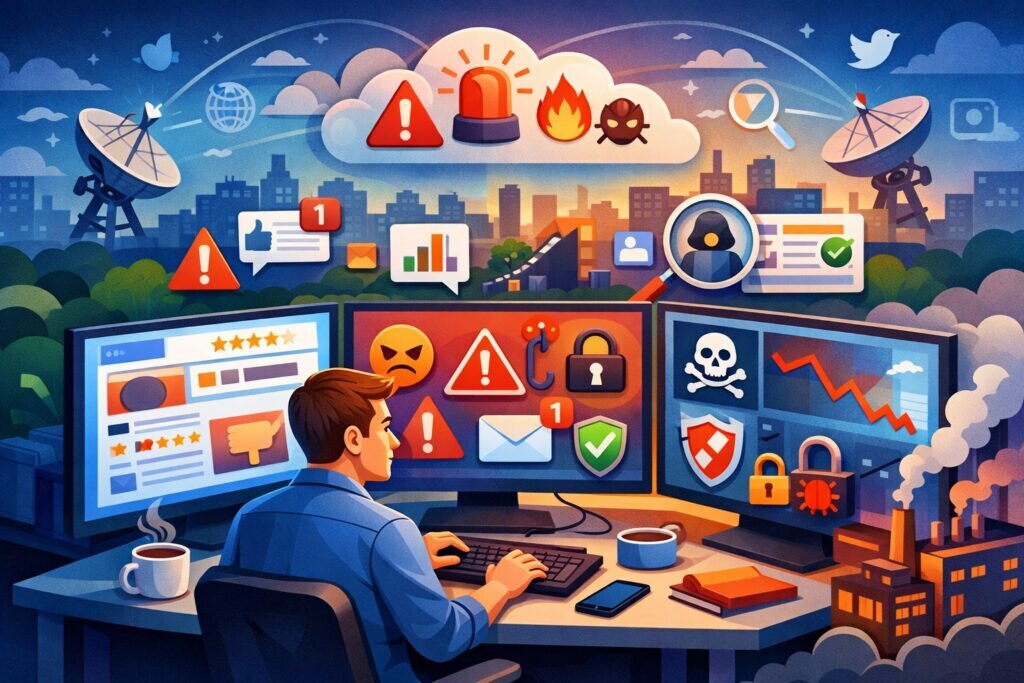
An effective early warning system isn’t one tool or one dashboard. It’s layered coverage across three areas: what people are saying about you, how your brand is performing in the market, and whether your technical infrastructure is secure.
Reputation signals include review sentiment shifts across platforms like Trustpilot, Google, and Facebook. If your average rating drops by half a star in a week, that’s not noise — that’s a signal. Fake reviews flooding your listings are another red flag that’s easy to miss without automated detection. You can read more about spotting these in how to detect fake reviews before they damage your brand.
Brand and marketing signals cover social media mention spikes, negative sentiment trends, and competitor movements that might indicate market shifts affecting you. A sudden increase in negative brand mentions on Reddit or Twitter often precedes mainstream media coverage by 48–72 hours. That’s your window.
Technical signals are the ones most brand managers overlook entirely. Your domain landing on a DNS or IP blacklist, a failed DMARC check, or a typosquatting domain appearing — these are crisis precursors. If your emails start hitting spam folders because your IP got blacklisted, your customer communication breaks down right when you need it most. Understanding the complete checklist for technical domain security is part of crisis readiness, not just an IT concern.
Building Your Early Detection Process Step by Step
You don’t need to boil the ocean. Start here:
1. Establish your baselines. You can’t spot anomalies if you don’t know what normal looks like. Track your average review rating, typical mention volume, sentiment ratio, and email deliverability rate for at least 30 days before you start reacting to data.
2. Set threshold alerts. Decide what constitutes a warning. For example: more than three negative reviews in 24 hours, a sentiment score drop of 15% week-over-week, or any new blacklist detection. These thresholds should trigger immediate notification — not a weekly report you read on Monday.
3. Monitor continuously, not periodically. Checking your reviews once a week is not monitoring. Reputation threats don’t wait for your schedule. Hourly automated checks across review platforms, social channels, and technical infrastructure give you realistic coverage. RepVigil runs 40 different tests on this cycle, covering everything from early crisis detection to blacklist monitoring, specifically because daily or weekly checks leave dangerous gaps.
4. Create a response playbook before you need it. Early detection is useless without a predefined response. For each alert type, document who gets notified, what the first response looks like, and what escalation means. A brand manager seeing a blacklist alert should know instantly whether to call IT or the email provider — not spend 40 minutes figuring out who owns the problem.
5. Review and calibrate monthly. Your thresholds will need adjustment. Some alerts will be too sensitive, others not enough. Treat your early warning system like a living process, not a set-and-forget tool.
The Real Cost of Detecting Late
Let me paint a realistic picture. A mid-size e-commerce company notices their customer acquisition cost creeping up over three weeks. Marketing blames ad fatigue and adjusts campaigns. Two weeks later, a journalist contacts them about a pattern of unresolved complaints on Trustpilot and a Reddit thread with 400 upvotes calling out their return policy. The actual problem started five weeks ago with a warehouse issue causing delayed shipments. Negative reviews followed, then social posts, then media interest.
With an early warning system, the review sentiment drop would have flagged the issue in week one. The social mention spike in week two would have confirmed it. By week three, they’d have been proactively reaching out to affected customers instead of fielding press inquiries in week five. The financial difference between these two timelines is often tens of thousands in lost revenue and recovery costs — not counting long-term brand damage. For a deeper look at these numbers, see the hidden costs of poor online reputation for businesses.
FAQ
How quickly can an early warning system detect a reputation threat?
With automated hourly monitoring, most emerging threats are flagged within hours of the first signals appearing. The key is continuous coverage — a system checking reviews, social mentions, and technical health every hour will catch patterns that weekly manual checks miss entirely. RepVigil’s automated approach is built around this principle.
Do small businesses really need crisis early warning, or is this just for large brands?
Small businesses are actually more vulnerable because they have less margin for error. One viral negative post can represent a much larger percentage of your total brand conversation. Automated monitoring levels the playing field — you don’t need a PR team on standby when your tools alert you the moment something shifts.
What’s the difference between reputation monitoring and early crisis detection?
Reputation monitoring tracks your overall brand health over time — review scores, sentiment trends, brand mentions. Early crisis detection is a specific function within that: identifying sudden changes in brand sentiment or technical anomalies that signal an emerging problem before it escalates. Think of monitoring as the dashboard and crisis detection as the warning light.
The bottom line is straightforward: crisis management doesn’t start when the crisis hits. It starts with the systems you put in place to see trouble forming. Automated, continuous, multi-layered monitoring is the difference between responding from a position of control and scrambling to catch up. Build your early warning system before you need it — because by the time you need it, it’s already too late to start.