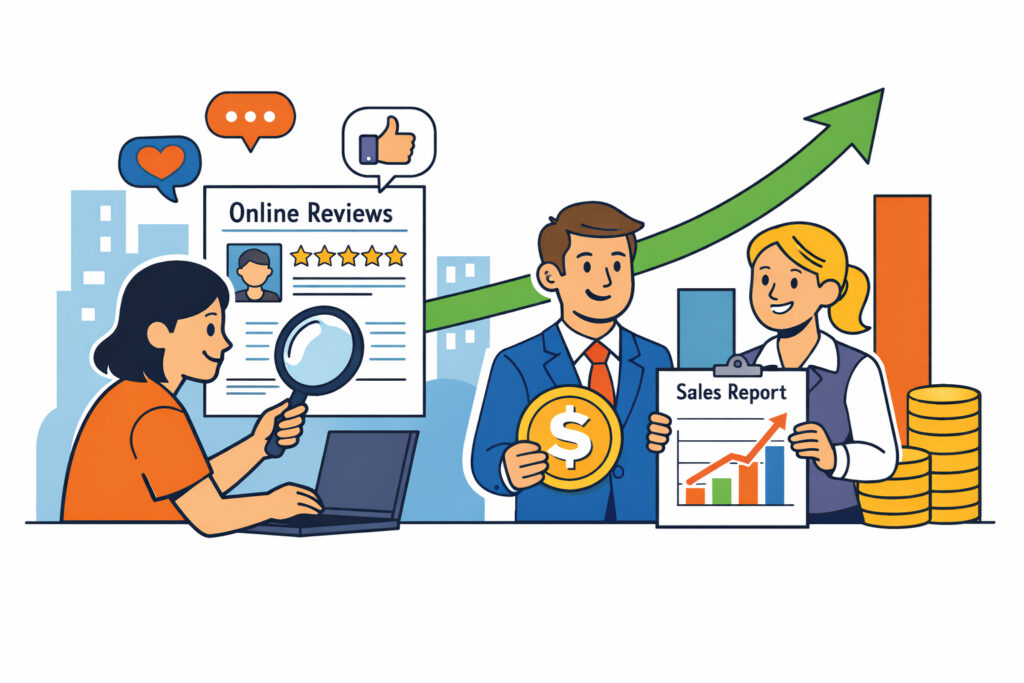
If you run a business in 2025, your online reputation is not just a “nice to have” – it directly affects how much money you make. The connection between online reputation and revenue growth is one of the most underestimated drivers in modern business strategy. Whether you sell software, run a restaurant chain, or manage a consulting firm, what people find when they search your brand name influences whether they buy, subscribe, or walk away. This article breaks down exactly how reputation translates into revenue – and what you can do to make that connection work in your favour.
Why Online Reputation Directly Impacts Your Bottom Line
Think about your own behaviour as a buyer. You Google a company, see a 3.2-star rating with complaints about slow support, and you move on. That decision takes about eight seconds. Now multiply that by hundreds or thousands of potential customers every month.
Research consistently shows that a one-star improvement on review platforms can lead to a 5–9% increase in revenue for service-based businesses. Conversely, a drop below 4.0 stars on Google or Trustpilot creates a measurable wall – conversion rates fall off sharply because buyers treat anything below that threshold as a warning sign.
The mechanism is simple. Reputation acts as a trust filter. Before prospects ever speak to your sales team or visit your store, they’ve already formed an opinion. If that opinion is negative – or even ambiguous – you lose the deal before it starts. The hidden cost isn’t just the lost sale. It’s the customer acquisition cost you already spent on ads, content, and outreach that brought that prospect to your doorstep, only for a bad review to turn them away. Understanding the hidden costs of poor online reputation is essential for any business owner serious about growth.
The Revenue Multiplier Effect of Strong Reputation
Here’s something most businesses miss: a strong reputation doesn’t just prevent losses – it actively multiplies revenue in ways that don’t show up in simple attribution models.
Pricing power. Companies with excellent reputations can charge 10–20% more than competitors with weaker public perception. Customers pay a premium for trust. If two SaaS tools offer similar features but one has glowing reviews and the other has silence, the trusted brand wins – and it wins at a higher price point.
Lower customer acquisition cost. Word-of-mouth and organic referrals driven by positive reputation reduce your dependence on paid advertising. A brand with strong reviews and sentiment gets more clicks on organic search results, higher email open rates, and better conversion at every stage of the funnel.
Customer retention. Reputation isn’t just about attracting new customers. It reinforces loyalty among existing ones. When your customers see other people praising your brand publicly, it validates their own decision. That validation reduces churn and increases lifetime value.
The Myth: “Our Product Speaks for Itself”
This is the single most dangerous assumption in business. Your product does not speak for itself – your customers speak for it, and they do so on platforms you may not even be watching.
I’ve seen businesses with genuinely excellent products lose market share because they ignored a growing cluster of negative reviews on one platform while focusing all their attention on another. A B2B company might obsess over G2 ratings while completely missing a thread on Reddit where former clients are sharing frustration about billing practices. Meanwhile, a competitor with an arguably inferior product but an active reputation management strategy captures the market.
The reality is that perception shapes buying decisions at least as much as product quality does. You need both – but without active reputation monitoring, even the best product loses revenue to brands that simply manage their public image better.
How to Turn Reputation Into a Revenue Growth Engine
Making this connection work requires a structured approach, not occasional check-ins.
Step 1: Establish your baseline. You can’t improve what you don’t measure. Start by assessing your current brand sentiment across digital channels – review platforms, social media, forums, and news mentions. Know where you stand before making changes.
Step 2: Monitor continuously, not quarterly. Reputation shifts happen fast. A single viral complaint or a coordinated fake review attack can undo months of positive momentum in days. Automated monitoring that checks your brand’s standing hourly – like RepVigil’s 40-test approach across reputation, marketing, and technical security – gives you the early warning you need to respond before damage compounds.
Step 3: Respond strategically to negative signals. Not every negative review needs a public response, but every negative trend does. If you notice review scores dipping on a specific platform, investigate the root cause. Is it a product issue, a support failure, or a competitor playing dirty with fake reviews? Each scenario demands a different response.
Step 4: Leverage positive reputation proactively. When your scores are strong, use them. Feature review snippets in ads. Add trust badges to landing pages. Share positive customer stories. Reputation data isn’t just defensive – it’s marketing ammunition.
Step 5: Track reputation alongside revenue metrics. Build a dashboard that correlates reputation scores with conversion rates, customer acquisition costs, and retention numbers. Over a 6–12 month period, the patterns become unmistakable. Businesses that do this consistently find reputation is their most reliable leading indicator of revenue trends.
Why Platform Coverage Matters More Than You Think
One common mistake is monitoring only one or two review platforms. Your customers are spread across Trustpilot, Google Reviews, Facebook, Reddit, Yelp, G2, Capterra, and industry-specific forums. A blind spot on any single platform means missed revenue signals.
For a thorough approach to this, read about why monitoring customer reviews across platforms matters. A complete picture of your reputation – not a partial one – is what allows you to make confident business decisions.
FAQ
How quickly can improving online reputation affect revenue?
Most businesses see measurable changes within 3–6 months of active reputation management. The fastest wins come from responding to existing negative reviews and resolving the underlying issues – this can improve conversion rates within weeks as updated reviews reflect better experiences.
Can a small business benefit from reputation monitoring, or is it only for large brands?
Small businesses often benefit even more. A single negative review has a proportionally larger impact when you only have 20 reviews compared to 2,000. Automated monitoring helps small teams stay on top of their reputation without dedicating a full-time employee to the task.
What’s the most common reputation mistake that hurts revenue?
Ignoring negative feedback. Many businesses assume bad reviews will get buried over time. They don’t. Unanswered complaints signal to potential customers that you don’t care – and that perception directly reduces conversions. Actively managing your online reputation management process is the single most impactful step you can take.
Your online reputation is not a vanity metric – it’s a revenue driver. The businesses that treat it as such consistently outperform those that don’t. Start measuring, start monitoring, and start connecting the dots between what people say about you and what your revenue reports show. The correlation is there. You just have to look for it.