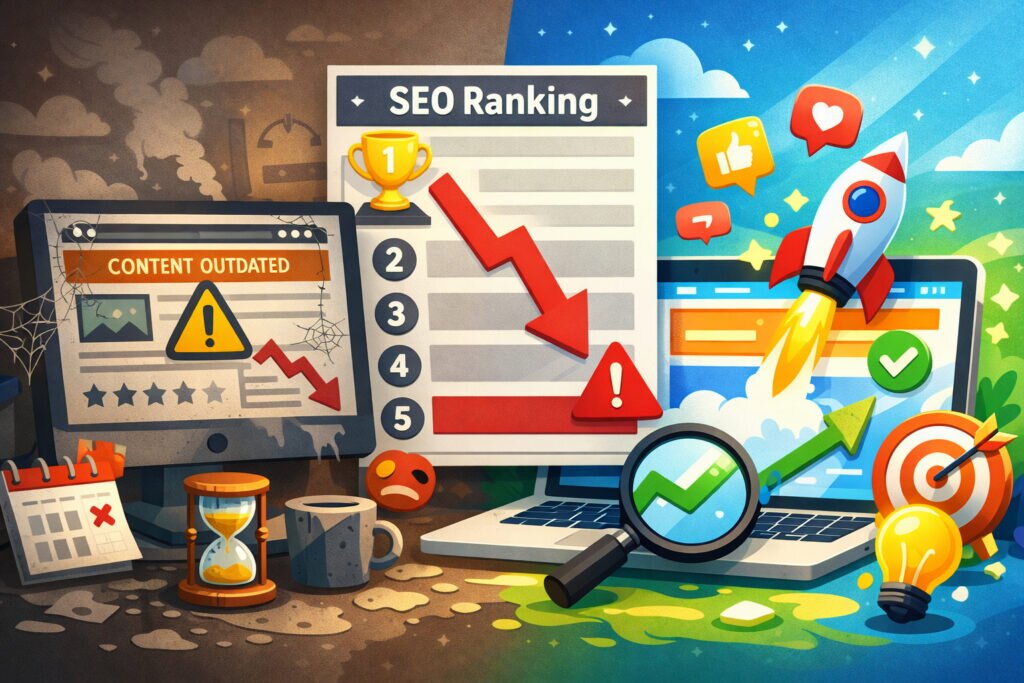
If you’re running a business website and wondering why your search rankings have been slipping, content freshness might be the culprit you haven’t considered. Outdated blog posts, stale product descriptions, and neglected landing pages quietly erode your visibility — and your credibility. This article explains exactly why outdated content hurts your rankings, how search engines evaluate freshness, and what you can do to keep your site competitive without rewriting everything from scratch.
What Content Freshness Actually Means for SEO
There’s a common misconception that content freshness simply means publishing new articles regularly. That’s only part of the story. Google’s freshness algorithms — originally introduced with the “Caffeine” update and refined through subsequent core updates — evaluate whether existing content still accurately reflects the current state of a topic.
For a page about “best email security practices,” for instance, an article written in 2021 that still references outdated SPF configurations or ignores DMARC enforcement trends will be seen as less relevant than a competitor’s updated guide. Google doesn’t just look at the publish date — it evaluates whether the substance matches what users need right now.
This matters especially in industries where information changes frequently: cybersecurity, digital marketing, SaaS, legal compliance, and reputation management are all areas where a six-month-old article can already feel dated.
How Outdated Content Actively Damages Your Rankings
It’s not just that fresh content ranks better — outdated content can actively pull your site down. Here’s how:
Lower click-through rates. When users see a 2022 date in search results and a competitor shows 2025, they click the newer result. Google notices this behavior and adjusts rankings accordingly.
Higher bounce rates. A visitor who lands on your “Complete Guide to Brand Monitoring” and finds references to defunct platforms or outdated statistics will leave immediately. That signals to search engines that your page didn’t satisfy the query.
Lost internal link equity. If older articles link to pages that no longer exist or to services you’ve restructured, those broken pathways waste crawl budget and confuse both users and search engines.
Reduced topical authority. Search engines build a picture of your site’s expertise over time. A cluster of outdated articles on a topic you claim to specialize in undermines that authority rather than reinforcing it.
The Myth: “Just Publish More New Content”
Here’s the myth that trips up most content teams: the belief that you can outrun stale content by simply publishing more. In reality, a site with 200 articles where 150 are outdated performs worse than a site with 50 well-maintained, current pieces.
I’ve seen this play out repeatedly. A brand invests heavily in content production for a year, then shifts focus. Two years later, their blog is full of articles referencing old pricing, discontinued features, and broken links. The site’s overall quality score drops, and even the newer articles struggle to rank because they exist alongside so much dead weight.
The solution isn’t more content — it’s a maintenance strategy. Audit what you have before creating anything new.
A Practical Content Freshness Audit in Five Steps
1. Identify your highest-traffic declining pages. Use Google Search Console to find pages that had strong impressions or clicks six months ago but are trending downward. These are your priority targets.
2. Check factual accuracy. Read each flagged article and verify that statistics, recommendations, and referenced tools or platforms are still current. If you’re writing about SPF, DKIM, and DMARC, make sure your advice reflects today’s enforcement standards, not last year’s.
3. Update dates and metadata. Once you’ve made substantive changes, update the publish date. Don’t just change the date without editing the content — search engines can detect that, and it’s considered a manipulative practice.
4. Fix or remove broken links. Every broken internal or external link is a small credibility hit. Redirect old URLs, replace dead links, and make sure your internal linking structure still makes sense.
5. Consolidate thin content. If you have three weak articles on closely related topics, merge them into one comprehensive resource. This concentrates your authority instead of diluting it across underperforming pages.
Content Freshness and Online Reputation Monitoring
Content freshness isn’t just an SEO concern — it directly ties into how your brand is perceived online. Outdated content on your own site can create a disconnect between what customers find in reviews across platforms and what your website actually says.
Imagine a potential customer reads a recent positive review mentioning your new feature set, then visits your blog and finds articles describing an old version of your product. That inconsistency damages trust. Your website content needs to keep pace with the reality that customers and review platforms reflect.
This is where automated monitoring becomes essential. Manually tracking whether your content aligns with what’s being said about your brand across review sites, social media, and news outlets is nearly impossible at scale. Services like RepVigil run continuous checks across dozens of reputation signals — from fake review detection to media monitoring — so you know immediately when there’s a gap between your public presence and your actual content.
How Often Should You Refresh Content?
There’s no universal schedule, but a practical rule of thumb works well:
Quarterly: Review your top 20 pages by traffic. Update statistics, check links, verify accuracy.
Biannually: Audit your full content library. Flag anything older than 18 months for review or consolidation.
Immediately: When your product, pricing, or service changes — or when an industry shift makes existing advice incorrect — update affected content the same week.
The brands that maintain rankings long-term treat content like a living asset, not a one-time investment.
FAQ
Does changing the publish date alone improve rankings?
No. Simply updating the date without making meaningful content changes is called “date manipulation,” and search engines can detect it. You need to make substantive edits — updated facts, new sections, refreshed examples — for the freshness signal to count.
Should I delete old content that’s no longer relevant?
Not always. If the page has backlinks or historical traffic, it’s usually better to redirect it (301) to a relevant current page or rewrite it entirely. Deleting pages without redirects creates 404 errors and wastes any link equity the page had accumulated.
How does content freshness relate to early crisis detection?
Outdated content can become a crisis trigger. If your website still promotes a discontinued product or makes claims that are no longer accurate, customers and competitors can use that against you. Keeping content current is a form of proactive reputation protection — it removes ammunition before problems start.
Content freshness isn’t glamorous work. It doesn’t have the excitement of a new product launch or a viral campaign. But it’s the foundation that keeps everything else visible. The businesses that treat their content library as something worth maintaining — rather than something to publish and forget — are the ones that hold their rankings year after year.