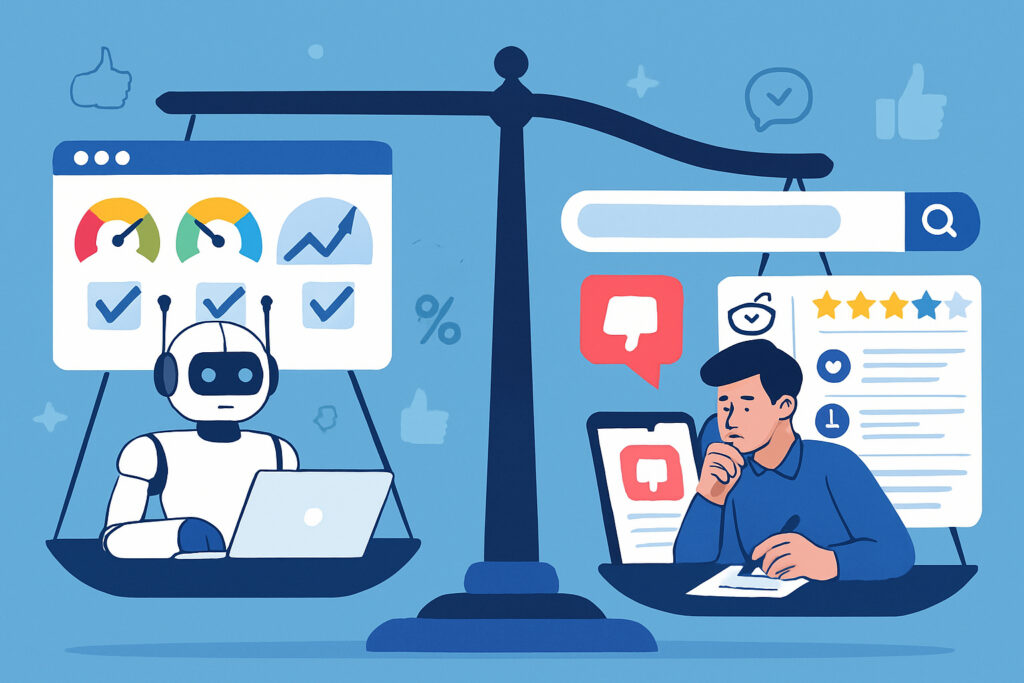
If you’re responsible for your company’s online reputation, you’ve probably wondered whether you should invest time in manual tracking or let automation handle it. I’ve been on both sides of this fence, and I can tell you the answer isn’t as straightforward as “one is always better.” But by the end of this article, you’ll know exactly which approach fits your situation—and why most businesses eventually land on a hybrid model.
The Reality of Manual Reputation Tracking
Let’s start with what manual tracking actually looks like in practice. You’re probably opening browser tabs every morning—checking Google reviews, scrolling through social media mentions, searching your brand name on Twitter, maybe setting up Google Alerts that flood your inbox. I spent six months doing exactly this for a client’s e-commerce brand, and here’s what happened: I missed a critical negative review on Trustpilot because I was focused on Facebook that day. By the time we caught it three days later, it had already influenced two potential customers who mentioned it in their own reviews.
Manual tracking gives you context and nuance. When you read a review yourself, you catch the subtle tone, understand the specific complaint, and can craft a personalized response. You notice patterns that algorithms might miss—like several customers mentioning the same shipping issue in different words. This human touch is valuable, especially for small businesses where every customer interaction matters deeply.
But here’s the problem: it doesn’t scale, and it’s exhausting. If you’re monitoring five platforms, spending 30 minutes on each daily, that’s 2.5 hours every single day. Miss a day because you’re sick or in meetings? You’ve got a backlog. Miss a weekend? You might miss a crisis brewing.
How Automated Monitoring Actually Works
Automated reputation monitoring uses software to continuously scan multiple platforms—review sites, social media, news outlets, forums, and search results—looking for mentions of your brand. The good systems check hourly or even more frequently, alerting you immediately when something needs attention.
The major advantage is coverage and speed. While you sleep, automated tools are watching. They track 40 different signals simultaneously—from customer reviews across seven platforms to DNS blacklists and phishing risks. They catch typosquatting domains registered overnight. They notice when your spam score suddenly jumps or when negative sentiment spikes on Reddit.
I implemented automated monitoring for a SaaS company last year, and within the first week, it caught a fake review campaign that started at 2 AM. Manual tracking would have missed those critical first hours when we could still respond quickly and minimize damage.
The Hidden Costs Nobody Talks About
Manual tracking seems free—it’s just your time, right? Wrong. Calculate what those daily hours cost in salary. Then add the opportunity cost of what else you could be doing with that time. For a marketing manager earning $70,000 annually, those 2.5 daily hours cost roughly $21,875 per year in salary alone.
Automated tools have upfront costs, but they’re typically far less than the hidden costs of manual tracking. More importantly, they reduce risk. The cost of missing a reputation crisis—lost customers, damaged brand value, emergency PR efforts—can dwarf any software subscription.
But automation has costs too: false positives that waste time, potential lack of context, and the need for someone to act on the alerts. A tool that sends 50 notifications daily becomes noise that people ignore.
When Manual Tracking Makes Sense
If you’re a small local business with minimal online presence—maybe 20 reviews total and a Facebook page—manual checking might work fine. Spending 15 minutes every few days keeps you informed without overwhelming you.
Manual tracking also shines for qualitative analysis. Once automated tools flag something, a human needs to read it, understand context, and decide how to respond. The best approach uses automation for detection and humans for interpretation and action.
Startups in their first year might prefer manual tracking while they’re still figuring out which platforms matter most. It’s a learning phase where hands-on interaction teaches you about your audience.
When Automation Becomes Essential
Once you’re monitoring more than three platforms, receiving more than 10 reviews monthly, or operating in multiple time zones, automation stops being optional. You physically cannot maintain adequate coverage manually.
E-commerce businesses, SaaS companies, healthcare providers, and anyone in crisis-prone industries need automated monitoring. The reputational stakes are too high and the volume too large for manual approaches.
If you’ve ever had a reputation crisis—a viral negative post, a coordinated review attack, or a data breach—you understand why real-time alerts matter. Manual tracking operates in hours or days; crises unfold in minutes.
The Hybrid Approach That Actually Works
Here’s what I recommend to most businesses: use automated monitoring as your early warning system and first line of defense, but keep humans in the decision-making loop.
Set up automated tracking for comprehensive coverage across all platforms. Configure alerts for critical issues—one-star reviews, negative sentiment spikes, blacklist appearances, security issues. Let the system monitor continuously while you focus on strategy and response.
Then dedicate specific time slots—maybe 30 minutes each morning—to review what the system flagged, read the actual content with human eyes, and decide on actions. This gives you the coverage and speed of automation with the judgment and context of human analysis.
Common Questions About Reputation Monitoring
How quickly do I need to respond to negative reviews? Studies show responding within 24 hours significantly improves outcomes. Automated monitoring makes this possible even for businesses without dedicated reputation teams.
Can’t I just use Google Alerts? Google Alerts are better than nothing but miss most review platforms, social media conversations, and technical reputation factors like DNS blacklists or phishing attempts.
What if automated tools send too many alerts? Good systems let you customize alert thresholds. Start with critical alerts only, then adjust based on your needs and capacity.
Is automated monitoring expensive? Many comprehensive tools are surprisingly affordable or even free during beta periods, costing less than a few hours of employee time weekly.
The truth is, manual tracking made sense a decade ago when online reputation meant watching a handful of review sites. Today’s digital landscape is too vast, too fast, and too important for manual-only approaches. Smart businesses use automation for monitoring and humans for meaningful responses—combining the strengths of both while avoiding their weaknesses.