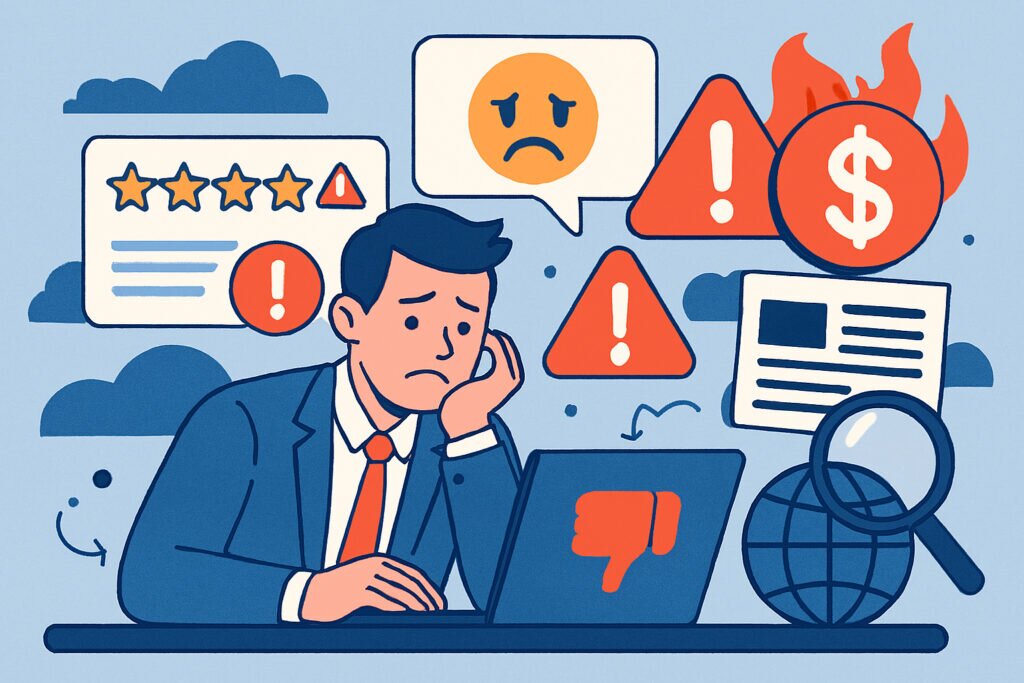
Most business owners focus on obvious expenses like rent, salaries, and marketing budgets. But there’s a silent profit killer that many completely overlook until it’s too late: a damaged online reputation. While you’re busy running daily operations, negative reviews, outdated information, and security issues might be quietly costing you thousands or even tens of thousands in lost revenue each month.
The financial impact of reputation damage isn’t always immediately visible in your accounting software, but it shows up in slower sales cycles, higher customer acquisition costs, and deals that mysteriously fall through at the last minute. Let’s look at what poor online reputation actually costs your business and why fixing it should be at the top of your priority list.
Lost Sales You’ll Never Even Know About
Here’s the uncomfortable truth: most potential customers who find something concerning about your business online won’t tell you. They’ll simply move on to your competitor. Research shows that 93% of consumers read online reviews before making a purchase decision, and 94% say negative reviews have convinced them to avoid a business entirely.
Think about your typical customer journey. Someone searches for your product or service, finds your website, and then does what everyone does—they check your reviews, Google your company name, look at your social media presence. If they find outdated information, unresolved complaints, or warning signs about your security, they’re gone. You’ve already paid for the marketing to get them there, but you get zero return.
I’ve seen this play out with a client who couldn’t figure out why their conversion rate suddenly dropped. They were getting traffic, but sales had declined by 30%. After digging deeper, we found a series of negative reviews on a platform they didn’t even know existed. The reviews were from a single disgruntled customer who had posted on multiple sites. Potential customers were finding these reviews during their research phase and walking away. The business was losing roughly $15,000 per month in revenue, and they had no idea why until someone pointed it out.
Higher Customer Acquisition Costs
When your online reputation is damaged, you need to work harder and spend more to acquire each new customer. Your advertising costs stay the same, but your conversion rates drop. This means your cost per acquisition skyrockets.
Let’s say you normally spend $50 to acquire a customer who’s worth $500 in lifetime value. That’s a healthy 10:1 return. But when reputation issues surface, maybe only half as many people who click your ads actually convert. Now you’re spending $100 to acquire that same customer, cutting your return in half. Multiply this across hundreds or thousands of potential customers, and you’re looking at substantial losses.
The worst part is that many businesses respond by increasing their ad spend, thinking they just need more traffic. But if the underlying reputation problem isn’t fixed, they’re just throwing good money after bad.
Employee Recruitment and Retention Problems
Your online reputation doesn’t just affect customer decisions—it impacts your ability to attract and retain talent. Job seekers research companies before applying, and current employees notice when their employer’s reputation takes a hit.
Companies with poor online reputations typically have to offer 10-20% higher salaries to attract the same quality of candidates. If you’re hiring even a handful of employees per year, this adds up to significant additional costs. And if employees leave because they’re embarrassed to work for a company with reputation issues, you’re facing recruitment costs, training costs, and productivity losses during the transition.
Security Incidents and Technical Vulnerabilities
Many businesses don’t realize that reputation monitoring includes technical security aspects that have real financial consequences. If your domain appears on email blacklists, your legitimate business emails might never reach customers. That sales email, that invoice, that customer support response—all potentially lost in spam folders.
Email deliverability issues alone can cost businesses 5-15% of their revenue. Imagine sending out quotes and proposals that never arrive. Following up with customers who think you’re ignoring them. Missing time-sensitive opportunities because your messages are blocked.
Then there are the costs associated with phishing attacks using your brand name, typosquatting domains that steal your traffic, or your business appearing on unsafe site lists. Each of these issues drives away customers and creates support headaches that consume staff time.
Crisis Management and Recovery Costs
When reputation issues finally become impossible to ignore, businesses often panic and make expensive mistakes. They hire PR firms charging $10,000-$50,000 per month. They launch emergency marketing campaigns. They offer deep discounts to win back customer trust, cutting into profit margins.
The companies that fare best are those who catch problems early through consistent monitoring. A negative review that’s addressed within 24 hours rarely becomes a crisis. But that same review, left to sit for weeks while generating follow-up complaints and social media attention, can spiral into a full-blown reputation emergency.
The Compounding Effect Over Time
Perhaps the most insidious aspect of reputation damage is how it compounds. One negative review might not hurt much. But when potential customers see that negative review and decide to pass, they never become positive reviews to balance it out. The ratio gets worse over time. Your star rating drops. Your ranking in search results declines. Fewer people even find your business in the first place.
I’ve watched businesses go from market leaders to struggling operations over 18-24 months, simply because they ignored reputation management. The decline started slowly—just a few more customer complaints, slightly lower conversion rates—but gained momentum as the problem fed on itself.
What Most Businesses Get Wrong About Reputation Monitoring
Many companies think reputation management means occasionally checking Google reviews and responding to comments on Facebook. But comprehensive reputation monitoring covers 40+ different factors across online reputation, brand marketing, and technical security.
You need to know about negative reviews across all major platforms, not just the one you check. You need alerts about phishing attempts using your brand. You need to know if your emails are being blocked or if competitors are outranking you for your own brand name. You need to catch Wikipedia edits and media mentions before they become problems.
Manual monitoring is nearly impossible at this scale. By the time you discover an issue, the damage has often already been done. Automated, hourly monitoring catches problems while they’re still small and fixable.
The Real Cost of Doing Nothing
Let’s put some actual numbers to this. A typical small business with poor online reputation management might experience:
– 20-30% lower conversion rates from paid advertising
– 15-25% reduction in organic traffic due to reputation signals affecting SEO
– 10-15% higher customer acquisition costs
– Lost deals worth $5,000-$50,000+ that fall through after prospects research the company
– Email deliverability issues affecting 10-30% of business communications
– Employee recruitment costs increased by 15-25%
For a business doing $500,000 in annual revenue, these hidden costs can easily total $50,000-$150,000 per year. For larger businesses, multiply these numbers accordingly.
The good news is that reputation problems are almost always fixable if caught early. The businesses that suffer the most are those who remain blind to the issues until they’ve already caused serious damage. Monitoring your reputation across all these dimensions isn’t optional anymore—it’s fundamental business hygiene, like keeping your books or maintaining your website.