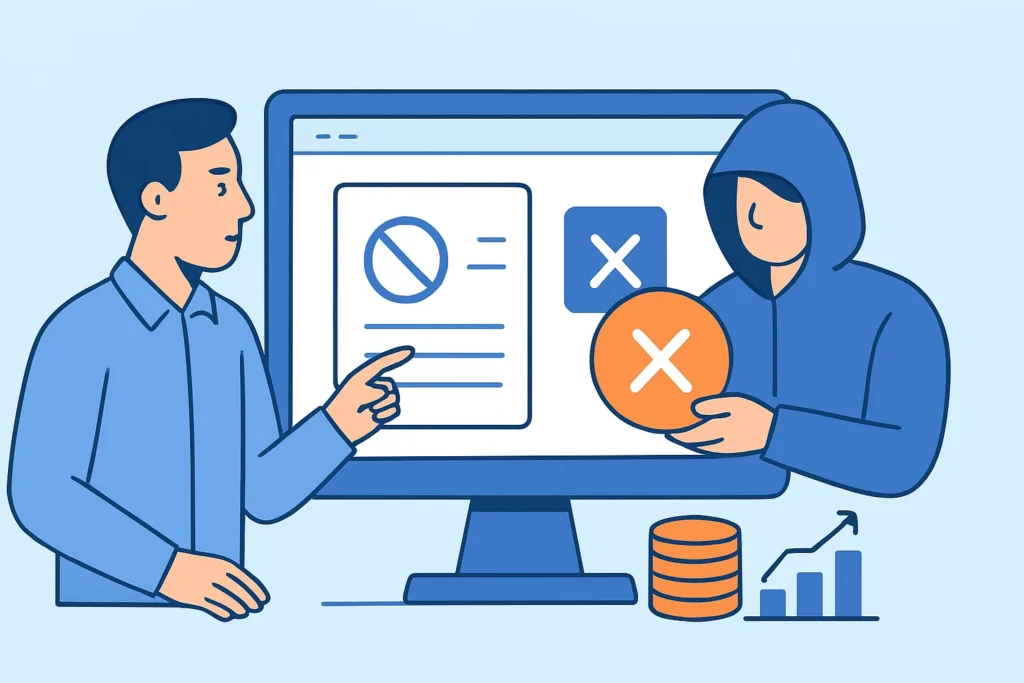
The EU Digital Services Act changed how businesses can challenge reviews on platforms like Google Maps, Amazon and Booking.com, but most brand managers still treat review takedowns as a matter of luck and support tickets. This guide explains what the Digital Services Act review takedown process actually allows: which reviews can be removed, how to file a notice that platforms have to process, and what to do when the answer is no. If you manage reputation for a business with EU customers, you will learn how to use the formal process instead of the “report” button.
What the Digital Services Act Changed for Review Platforms
The Digital Services Act (Regulation (EU) 2022/2065) applied to the largest platforms from 25 August 2023 and to almost all online platforms from 17 February 2024. Before that, removing a review depended on each platform’s own policies and its patience with your support tickets. Now there is a legal framework with deadlines, written reasons and ways to appeal.
The key provisions for review monitoring are Article 16 (notice-and-action mechanisms), Article 17 (statement of reasons), Article 20 (internal complaint handling) and Article 21 (out-of-court dispute settlement). Very Large Online Platforms – those with more than 45 million monthly EU users, including Google Maps, Amazon Store and Booking.com – also face systemic risk audits. Fines can reach 6% of global annual turnover.
These rules are why platforms now have dedicated “report illegal content” forms. Those forms are separate from the ordinary “flag as inappropriate” option.
Myth: The DSA Lets Businesses Remove Negative Reviews
It doesn’t. This is the most common misconception, and it wastes weeks of effort. The DSA does not give businesses any right to remove a review because it is harsh, unfair or bad for revenue. It sets up a process for reporting illegal content, and what counts as illegal comes from EU or national law, not from the DSA itself.
A genuine one-star review complaining about cold food is legal speech. It stays up. In practice, two categories qualify. The first is defamation under national law, such as false claims of fact like “this clinic reuses needles” when that is untrue. The second is fake reviews. Under the Omnibus Directive (2019/2161), in force since 28 May 2022, posting or commissioning fake consumer reviews is a banned commercial practice across the EU. That puts review fraud, whether competitor-driven or bought, squarely within scope.
Reviews that break platform rules without being illegal, such as off-topic rants or conflicts of interest, are handled under Article 14. It requires platforms to enforce their own terms “diligently, objectively and proportionately”. This is a weaker tool, but it still counts.
Filing a Notice That Platforms Must Process
An experienced reputation manager treats an Article 16 notice like a short legal brief, not a complaint. A notice that meets the formal requirements creates “actual knowledge” for the platform. Once the platform knows, it loses its liability shield if it ignores clearly illegal content. That gives your notice real weight.
A valid notice contains:
– The exact URL of each review, not just your business profile
– A clear explanation of why the content is illegal, citing the specific law
– Your name and email address
– A statement that you believe in good faith that the notice is accurate and complete
– Supporting evidence, such as booking records showing the reviewer was never a customer
Use the platform’s dedicated DSA form. Google, Amazon and Meta all have one, separate from in-app flagging. Screenshot each review with its timestamp before you submit, because content sometimes changes or disappears during review. Keep a log of notice IDs. Under Article 17, the reviewer gets a statement of reasons if their review is removed, and you get told the decision. Most large platforms answer within 3-14 days, but the DSA only requires processing in a “timely” manner, with no fixed deadline.
A Realistic Scenario: The 48-Hour Review Spike
Picture a mid-sized restaurant group with four locations in Germany and Austria. Over 48 hours, one location gets 17 one-star Google reviews. Eleven come from accounts with no other reviews, several use near-identical wording, and none match a reservation in the booking system. Fake review detection flags the spike within hours.
The rushed response is to flag all 17 through the in-app button and hope. The better response separates them. The eleven likely fakes go into one DSA notice that cites the Omnibus Directive’s ban on fake reviews and the matching German unfair competition law (UWG), with booking-system exports attached. Two reviews claiming food poisoning without evidence are judged as possible defamation and passed to counsel. The four remaining reviews look like real customers having a bad night, so they get a public reply instead. For those, guidance on responding to negative reviews without making it worse matters more than any takedown process.
A typical result in this kind of case is that most of the bundled fakes come down within about a week. The legitimate reviews stay, and that is correct.
When the Platform Says No
A rejected notice is not the end of the road. Under Article 20, you can file an internal complaint free of charge within six months of the decision. The platform must review it with human involvement, not only automated systems.
If that also fails, Article 21 lets you go to a certified out-of-court dispute settlement body. Appeals Centre Europe, certified in Ireland in late 2024, handles disputes involving Facebook, TikTok and YouTube, among others. These bodies cannot force a platform to comply, but platforms must engage in good faith. If you win, the platform pays the fees. For businesses that also sell in the US, the FTC rules on fake reviews add a parallel regulatory angle worth knowing.
Edge Cases Where Standard Advice Fails
Platforms that qualify as micro or small enterprises (fewer than 50 staff and under €10 million turnover) are exempt from Article 20 and 21 obligations. A niche industry review site may legally offer no appeal at all. Article 16 still applies to them.
Defamation is national law, so outcomes vary. A review that is clearly unlawful under Germany’s § 186 StGB may not be unlawful in another member state. Platforms often respond by geo-blocking the review in one country instead of deleting it everywhere. The UK left the EU and falls under the Online Safety Act 2023 instead, and DSA notices carry no weight for UK-only disputes. Regulated sectors such as healthcare face an added complication: replying publicly with patient details to rebut a review can breach GDPR, even when the review itself is false.
Common Mistakes in DSA Review Takedowns
The first mistake is mass-reporting every negative review. Article 23 lets platforms suspend notice handling for anyone who frequently submits manifestly unfounded notices. A business that files 40 weak notices can lose credibility exactly when it needs to report a real attack.
The second is waiting. A notice filed three months after a review spike, with no timestamped evidence, is much harder to support. Hourly review monitoring helps here because the evidence is still fresh.
The third is skipping the legal grounding. Writing “this review is false and hurts our business” without naming a law gives the platform an easy reason to reject the notice. When claims involve serious factual allegations, it helps to know when to involve lawyers and when not to.
FAQ
Can I use the DSA if my business is outside the EU?
Yes. The DSA applies to platforms serving EU users, not to where the notifier is based. A US or Swiss business can file an Article 16 notice about reviews on an EU-facing platform.
How long does a platform have to respond to a DSA notice?
The DSA has no fixed deadline. It requires “timely, diligent, non-arbitrary and objective” processing. Major platforms typically decide within 3-14 days, and you must be told the outcome.
Will the reviewer know I reported them?
The reviewer gets a statement of reasons explaining the removal. Platforms generally do not reveal the notifier’s identity, but you should assume the reviewer will connect the removal to your business.
Final Practical Tip
The DSA rewards businesses that prepare before a review attack, not those that react afterwards. Keep a ready-made notice template with the relevant national laws already cited, a record of which platforms’ DSA forms you have used, and a habit of capturing evidence the same day a suspicious review spike appears. Save takedown requests for genuinely illegal content and reply to everything else. That keeps your notices credible and your digital reputation intact.