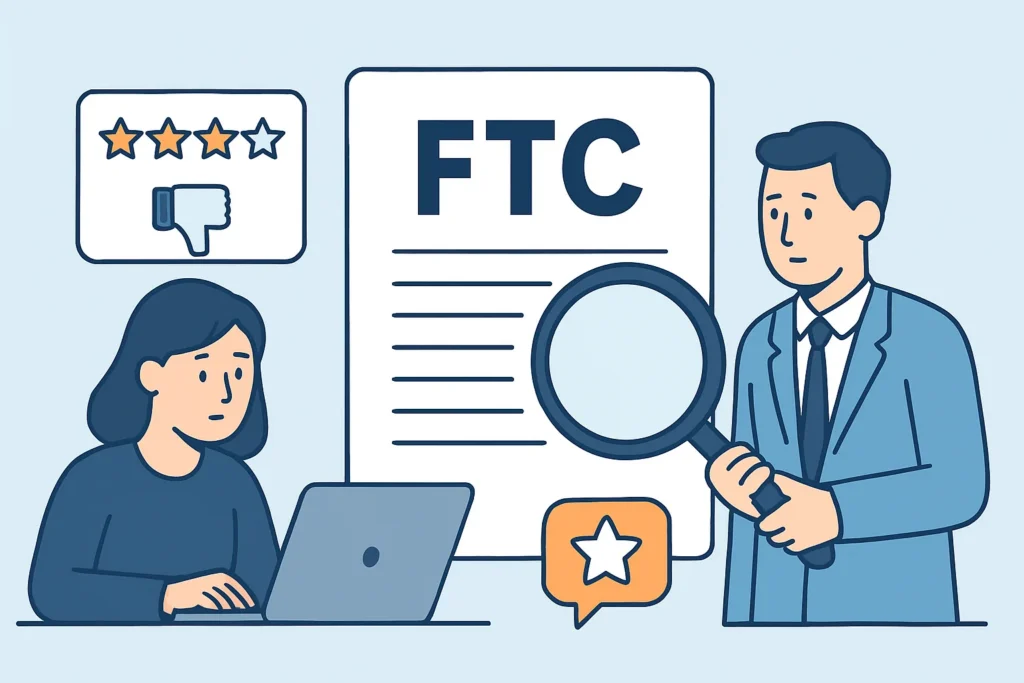
The FTC fake reviews rule has been fully enforceable since October 21, 2024, so a brand that collects, displays or responds to customer reviews can now face civil penalties for practices that used to bring a warning letter at most. This article covers what the FTC fake review rules actually prohibit, who is liable, where the gray areas are, and how marketing and reputation teams can audit their own processes before a regulator or a competitor does it for them.
The short version: the rule (16 CFR Part 465, finalized in August 2024) targets the whole review supply chain, not only the person typing a fake five-star post. Brands that buy, commission, gate, suppress or quietly write reviews themselves are the main target.
What the Consumer Review Rule Actually Prohibits
The rule turns long-standing FTC guidance into enforceable regulation. That matters because of the money. Under Section 5 of the FTC Act alone, the agency usually could not seek civil penalties for a first offense. Under the new rule, it can seek more than $50,000 per violation, and that figure is adjusted for inflation every year. When each fake review can count as a separate violation, a batch of 200 purchased reviews becomes a very expensive line item.
The core prohibitions fall into a handful of categories:
Fake or false reviews – reviews from people who don’t exist, people who never used the product, or reviews that misrepresent the reviewer’s experience. AI-generated reviews are explicitly included.
Buying or selling reviews – including paying for reviews where the payment is conditioned on a positive (or, against competitors, negative) sentiment.
Undisclosed insider reviews – reviews by officers, managers, employees or agents without clear disclosure of the relationship, plus cases where a company asks employees or their relatives to post reviews.
Review suppression – using unfounded legal threats, intimidation or false accusations to remove negative reviews, or presenting a filtered review set as if it were complete.
Fake social media indicators – buying followers, views or engagement that the buyer knew or should have known were fake, when used to misrepresent influence for commercial purposes.
The rule also bans company-controlled “independent” review sites that rank the owner’s own products first without disclosure.
Myth: Incentivized Reviews Are Now Illegal
This is the most common misreading. The FTC rule does not ban offering an incentive for a review. It bans conditioning the incentive, explicitly or implicitly, on the review being positive. A $10 voucher for “anyone who leaves an honest review” is permitted under the rule if the incentive is disclosed. A $10 voucher “for your 5-star review” is a violation.
The catch is that platform policies are stricter than federal law. Amazon prohibits paying for reviews outside its Vine program, Google’s review policies prohibit offering incentives for reviews, and Yelp tells businesses not to ask for reviews at all. Staying FTC-compliant does not keep a business listing safe. A practitioner checks both layers: the regulation and the terms of each platform where reviews actually live.
A Scenario Most Brand Managers Will Recognize
A mid-sized home goods brand launches a new product line. Early ratings on its own site are thin – 14 reviews, average 3.9. The growth team sets up a post-purchase email flow: customers who click “Loved it!” get a link to Google and Trustpilot, while customers who click “Not for me” are sent to a private feedback form. Separately, the sales director asks the team to “help seed some reviews” from friends and family.
Within six weeks the average climbs to 4.7. It looks like a success. It is actually three separate risks: the review gating violates Google’s and Trustpilot’s policies, the friends-and-family reviews are undisclosed insider reviews under the FTC rule, and the on-site widget that hides reviews below three stars misrepresents the full picture to buyers. None of it took bad intent. It took an agency brief, an enthusiastic director and nobody asking who owned compliance.
Common Mistakes Brands Make With FTC Fake Review Rules
Treating employee reviews as harmless enthusiasm. Staff posting “Great company, great products!” on Google without disclosing their employment is exactly what the insider provision covers. If the business runs an advocacy program, it needs written disclosure rules. The guide on employee advocacy programs covers how to structure one so it doesn’t backfire.
Threatening reviewers with legal action as a first move. A cease-and-desist letter over a harsh but honest one-star review is now potentially a review-suppression violation, on top of the Streisand effect. The 2016 Consumer Review Fairness Act already voids non-disparagement clauses in consumer contracts. Before calling counsel, it helps to understand when legal action against online content is actually justified – genuine defamation is a narrow category.
Outsourcing reviews to agencies without auditing them. “We used a vendor” is not a defense when the brand knew or should have known. The FTC’s 2022 settlement with Fashion Nova, which paid $4.2 million over suppressing negative reviews through a third-party review widget, shows that tooling choices end up on the brand.
How to Audit Your Review Practices in Five Steps
An experienced compliance-minded marketing lead usually handles this in a two-week sprint.
First, map every review touchpoint: post-purchase emails, SMS flows, packaging inserts, on-site widgets (Yotpo, Judge.me, Bazaarvoice and similar tools), and any agency or influencer contract that mentions reviews. Second, read every request message and incentive offer and remove anything tied to sentiment, including the soft “if you’re happy, please…” phrasing on links that only go to public platforms.
Third, check display settings. Does the widget hide low ratings, delay them, or sort them out of view by default? Moderation for profanity, spam or personal data is fine. Filtering by star rating is not. Fourth, collect a signed list of employees, contractors and relatives who have reviewed the product, and add disclosures or ask for removal. Fifth, set up ongoing monitoring for sudden review spikes, clusters of similar wording and new reviewer accounts – patterns covered in detail in the guide to detecting fake reviews before they damage your brand. That last step also catches competitors buying reviews for you to frame you, which happens more often than most teams expect.
Edge Cases and Where the Rule Does Not Simply Apply
The rule governs US commerce, but non-US brands selling to US consumers are within reach. Brands operating in Europe face parallel obligations: the EU Omnibus Directive has required businesses since 2022 to disclose whether and how they verify reviews, and the UK’s DMCC Act 2024 banned fake reviews outright from April 2025, with the CMA able to fine up to 10% of global turnover.
Regulated industries add another layer. Healthcare providers responding to reviews must also avoid HIPAA disclosures, and law firms are bound by state bar advertising rules on testimonials. Very small teams – a five-person café, for example – are less likely to be investigated first, but the rule has no small-business exemption, and platform penalties like Google’s review removal and profile warnings hit them hardest.
FAQ
Can a business still ask customers for reviews under the FTC rule?
Yes. Asking for reviews is legal. The request must go to all customers, or a neutral sample, and must not reward or route customers based on whether they are likely to be positive.
Is a brand liable for fake reviews posted by a competitor or a stranger?
Generally no, unless the brand procured or knowingly benefited from them. Documenting that it flagged and reported suspicious reviews to the platform is a sensible precaution.
Do the FTC fake review rules cover AI-written reviews?
Yes. Reviews generated by AI that misrepresent a real person’s experience are expressly treated as fake. Using AI to help a genuine customer phrase their own experience is a grayer area, but the experience must be real.
Final Practical Tip
The FTC fake review rules punish what a brand does to its reviews, not having bad reviews in the first place. A 4.3 average built on honest, unfiltered feedback is safer and, for most buyers, more believable than a perfect 4.9. Assign one named owner for review compliance, re-audit every flow at least twice a year, and treat any review vendor’s promise of “guaranteed ratings” as a reason to walk away.