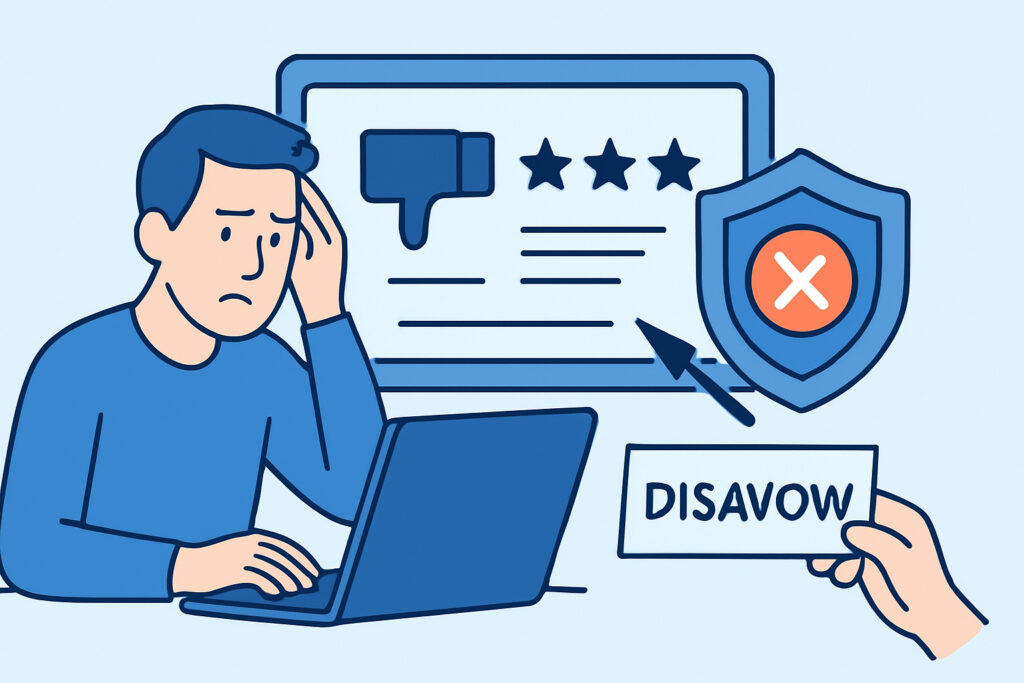
Negative SEO attacks are one of the more frustrating threats a brand can face online, because the damage is done by someone else while search engines quietly penalize the victim. Recognizing the signs early and knowing how to build a disavow strategy can mean the difference between a temporary ranking dip and months of lost organic traffic.
A negative SEO attack happens when a competitor or malicious actor deliberately tries to harm a website’s search rankings through manipulative tactics rather than legitimate marketing. This is different from a hacking attempt or a defamation campaign – the attacker isn’t trying to steal data or post bad reviews, they’re trying to make Google itself turn against the target site. It’s a quieter, more technical form of reputation damage, and it often goes unnoticed until rankings have already dropped.
What Negative SEO Actually Looks Like in Practice
The most common form is a spam link attack: thousands of low-quality, irrelevant, or clearly artificial backlinks pointed at a target domain in a short period of time, often from gambling, adult, or pharmaceutical sites in languages unrelated to the business. The goal is to make the site’s backlink profile look manipulated, triggering algorithmic distrust or a manual action.
Other variants include scraping and republishing a site’s content on multiple domains to create duplicate content confusion, hacking a site to inject spammy pages, or even leaving a flood of fake negative reviews timed to coincide with a link spam campaign. A consulting firm noticing an unexplained 40% traffic drop over three weeks, paired with a spike of backlinks from unrelated foreign-language domains in Search Console, is a textbook example – the timing and the nature of the links are what give it away, not just the ranking loss itself.
Early Warning Signs Worth Tracking
A few patterns tend to show up before rankings visibly suffer:
A sudden, unnatural spike in referring domains, especially from sites with no topical relevance. A cluster of new links using the exact same anchor text, which real link-building rarely produces. Duplicate versions of site content appearing on unfamiliar domains. A wave of low-quality reviews or directory listings created without the business’s involvement. Search Console manual action or security notices arriving with no internal changes to explain them.
None of these alone is proof of an attack – link spikes can also happen from legitimate viral content. The pattern matters more than any single data point, which is why regular monitoring of backlink profiles and domain health is far more useful than checking only after rankings drop.
Why the Disavow Tool Is Not a First Response
This is where a common misconception causes real harm: many site owners assume that disavowing links is the immediate fix for any suspicious backlink activity. In reality, Google has stated repeatedly that its algorithms are generally good at ignoring low-quality links without any ranking impact, and indiscriminate disavowing can do more damage than the original spam. Removing links that Google was already discounting doesn’t help, and disavowing too broadly – or too often – can strip away legitimate link equity a site actually needs.
The disavow tool exists for two specific situations: when a site has received a manual action tied to unnatural links, or when there is clear, unambiguous evidence of a sustained, targeted spam attack that a site owner cannot get removed through outreach. It is a last resort, not a routine maintenance task.
Building a Response Strategy Step by Step
Document everything first. Export the full backlink profile from Search Console and a third-party tool, and keep timestamped records of the spike. This matters if a manual action review or legal step becomes necessary later.
Separate the signal from the noise. Filter for genuinely toxic patterns – foreign-language spam networks, private blog networks, adult or gambling sites with zero topical connection – rather than flagging every unfamiliar domain.
Attempt outreach where realistic. For any domain that looks like it might respond, a removal request is worth sending, even if the response rate is low. It creates a paper trail showing good-faith effort.
Only then build the disavow file, scoped narrowly to domains matching the confirmed spam pattern, submitted at the domain level rather than link-by-link where the pattern is consistent.
Monitor recovery over weeks, not days. Disavow files take time to be processed and reflected in rankings, so expect a delayed response rather than an immediate reversal.
Keep watching afterward. A single attack is rarely a one-time event; attackers who succeeded once often repeat the tactic, so ongoing backlink and domain monitoring should continue well past the initial incident.
Technical footholds are just as often abused alongside link spam – a compromised subdomain, an expired asset, or a lookalike domain can all be leveraged to reinforce a negative SEO campaign, which is why domain abuse prevention deserves attention in the same review, not as a separate task.
Reducing Exposure Before an Attack Happens
The businesses that recover fastest are usually the ones already tracking their backlink and domain signals as part of normal operations, not scrambling to build a monitoring process after traffic has already dropped. Keeping a baseline understanding of a site’s typical referring domain growth rate makes anomalies far easier to spot. Reviewing domain reputation scores periodically also helps catch blacklist or trust issues that often accompany a coordinated spam campaign.
It’s also worth periodically auditing the site itself for injected spam content, since some negative SEO campaigns combine external link attacks with attempts to plant spammy pages or redirects directly on the target’s own domain through vulnerable plugins or outdated software – a pattern covered in more depth in SEO spam detection practices.
FAQ
Can negative SEO attacks actually get a website removed from Google entirely?
It’s extremely rare for spam links alone to cause outright removal. What typically happens instead is a gradual ranking decline or, in more severe cases, a manual action affecting visibility for specific pages or the whole site. Full removal usually requires a serious policy violation, not just an incoming link spike.
How long does it take to recover after disavowing spam links?
Recovery timelines vary, but most site owners report meaningful changes within four to twelve weeks after submitting a disavow file, since Google needs to recrawl and reprocess the affected links. Sites with an existing manual action typically also need to file a reconsideration request before recovery begins.
Is negative SEO illegal?
In many jurisdictions, deliberately sabotaging a competitor’s search rankings can fall under unfair competition or interference laws, though enforcement is difficult because attribution is hard to prove. Most businesses focus on defense and recovery rather than pursuing legal action, since identifying the attacker with certainty is rarely straightforward.
Negative SEO attacks are unsettling precisely because the damage happens on a platform the target doesn’t control, but they are rarely as catastrophic as they first appear. Careful documentation, a narrowly scoped response, and consistent monitoring of backlink and domain health turn a stressful incident into a manageable one – and often prevent it from becoming a recurring problem in the first place.