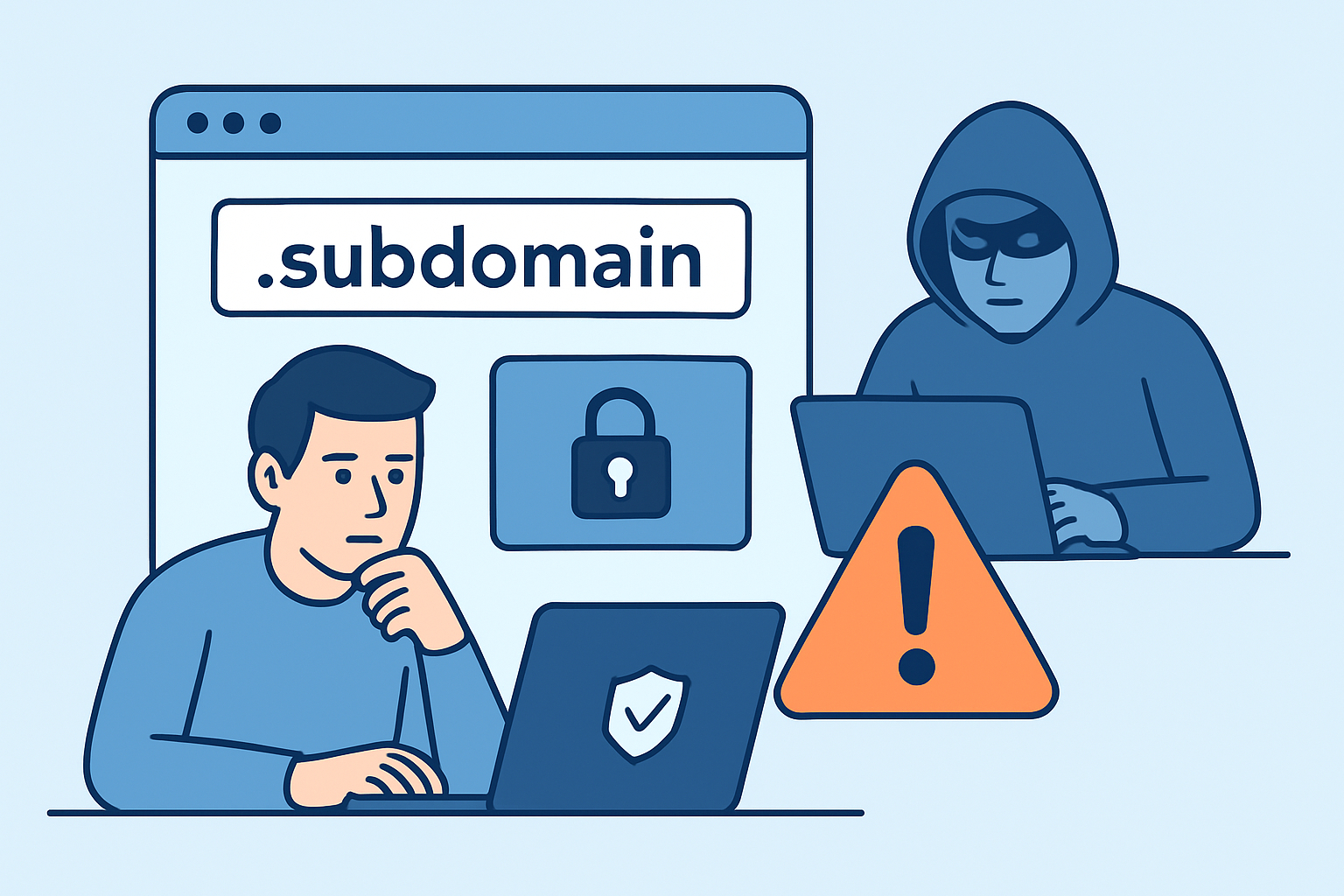
Subdomain takeovers rarely make headlines the way a data breach does, yet they quietly expose businesses to phishing campaigns, malware distribution, and brand impersonation that can undo years of trust-building in days. Subdomain security is the practice of tracking, securing, and retiring every subdomain a business creates, so that abandoned or misconfigured entries can’t be hijacked by outside parties and turned into a weapon against the brand that owns the parent domain.
Most companies focus their security attention on the main website. Marketing teams spin up promo.brand.com for a campaign, sales sets up a demo.brand.com for a product trial, and IT configures staging.brand.com for testing. Six months later the campaign ends, the demo environment is decommissioned, but the DNS record pointing to it never gets removed. That orphaned record is exactly what attackers look for.
What a subdomain takeover actually looks like
A subdomain takeover happens when a DNS record – typically a CNAME – still points to a third-party service (a cloud host, a page builder, a CDN) that the business has stopped using. Because the DNS entry is still live, but the underlying resource has been deleted or the account has expired, an attacker can register that same resource on the third-party platform and effectively “claim” the subdomain.
Once claimed, the attacker controls what appears at that address. Since the subdomain still resolves under the trusted brand.com domain, browsers, spam filters, and even employees see it as legitimate. That trust gets abused in a few common ways:
Phishing pages hosted on a subdomain that looks completely authentic, because technically it is part of the real domain. Malware distribution disguised as a software update or download page. Cookie or session hijacking if the subdomain shares a parent domain with authenticated services. Reputational damage when search engines or security vendors flag the parent domain as unsafe, dragging down the main website’s trust score along with it.
Why this attack vector gets overlooked
Subdomain sprawl tends to happen gradually, which is exactly why it’s dangerous. A single subdomain rarely feels like a security decision – it feels like a routine marketing or engineering task. Nobody schedules a “delete the subdomain” step when a campaign wraps up, because it isn’t seen as an asset that needs decommissioning.
Larger organizations often lose track entirely. Different departments provision subdomains independently through cloud consoles, marketing platforms, and third-party SaaS tools, with no central register. A business can easily have forty or fifty active subdomains and only be actively using a dozen of them. Every unused one is a potential entry point.
Common myth: only misconfigured DNS causes takeovers
A persistent misconception is that subdomain takeovers only happen because of technical misconfiguration on the business’s side, and that once DNS is “set up correctly,” the risk disappears. In reality, the takeover risk is created by the lifecycle mismatch between DNS records and the services they point to. A subdomain can be configured perfectly on day one and still become vulnerable eighteen months later, the moment the linked cloud service, hosting account, or third-party app is cancelled and nobody updates the DNS record to match. This isn’t a one-time setup problem – it’s an ongoing asset management problem.
A practical scenario
Consider a mid-sized retailer that ran a seasonal promotion through a third-party landing page builder, pointed to offers.retailbrand.com. The promotion ended after eight weeks and the marketing team cancelled the landing page subscription, assuming that was the end of it. The CNAME record in DNS, however, was never removed.
Four months later, someone registered that same landing page slug on the third-party platform and built a convincing fake login page mimicking the retailer’s checkout flow. Because it lived on offers.retailbrand.com, customers clicking old promotional links – still indexed in search results and circulating in old emails – landed on what looked like an official page. Several customers entered payment details before the retailer’s security team even knew the subdomain still existed. The fix took twenty minutes once discovered; discovering it took four months.
How to secure subdomains before they become a liability
Inventory every subdomain. Use DNS enumeration tools or a subdomain scanner to build a complete list of everything resolving under the primary domain, not just the ones marketing or IT remember creating.
Match every record to an active owner and purpose. If a subdomain can’t be tied to a currently running service, it’s a candidate for removal.
Remove DNS records the moment a service is decommissioned. Make this a mandatory step in the offboarding checklist for any campaign, trial environment, or third-party integration, not an afterthought.
Monitor DNS changes continuously. New subdomains and altered records should trigger an alert, since attackers sometimes create subdomains outright rather than hijacking existing ones. Reviewing the fundamentals in DNS security basics is a useful starting point for teams that haven’t audited their DNS hygiene recently.
Restrict who can create subdomains. Centralize DNS management so that any department needing a new subdomain goes through a documented request process instead of self-service sprawl.
Check for dangling CNAMEs specifically. These are the single most common cause of takeovers, and several free scanning tools exist purely to flag them.
For businesses that want a broader framework covering not just subdomains but the full range of DNS, email authentication, and domain-level risks, a full technical domain security checklist helps structure the review so nothing gets missed. Subdomain takeovers also overlap heavily with brand impersonation tactics, since attackers use the same trust exploitation logic whether they’re hijacking a subdomain or registering a lookalike domain – the guide on preventing brand impersonation and domain abuse is worth pairing with a subdomain audit.
Frequently asked questions
How often should subdomains be audited?
Quarterly audits are a reasonable baseline for most businesses, though companies running frequent marketing campaigns or using many third-party SaaS integrations benefit from monthly checks. Continuous DNS monitoring reduces the need for manual audits by flagging changes as they happen.
Can a subdomain takeover affect the main domain’s search rankings?
Yes. If a subdomain gets flagged for phishing or malware by browsers or search engines, that warning can affect trust signals tied to the parent domain, and in some cases trigger safe browsing warnings that scare away visitors to the main site as well.
Are subdomains created by third-party marketing tools a bigger risk than internally hosted ones?
Generally yes, because the business doesn’t fully control the lifecycle of the underlying resource. When a marketing platform, page builder, or cloud service account is cancelled, the DNS record pointing to it becomes dangling unless someone manually removes it – which is precisely the gap attackers exploit.
Subdomain security isn’t a one-time project; it’s ongoing housekeeping that has to keep pace with how many teams are creating digital assets under a company’s name. The businesses that stay ahead of this risk treat every subdomain as a tracked asset with a clear owner and an expiration plan, rather than something that quietly exists until an attacker finds it first.