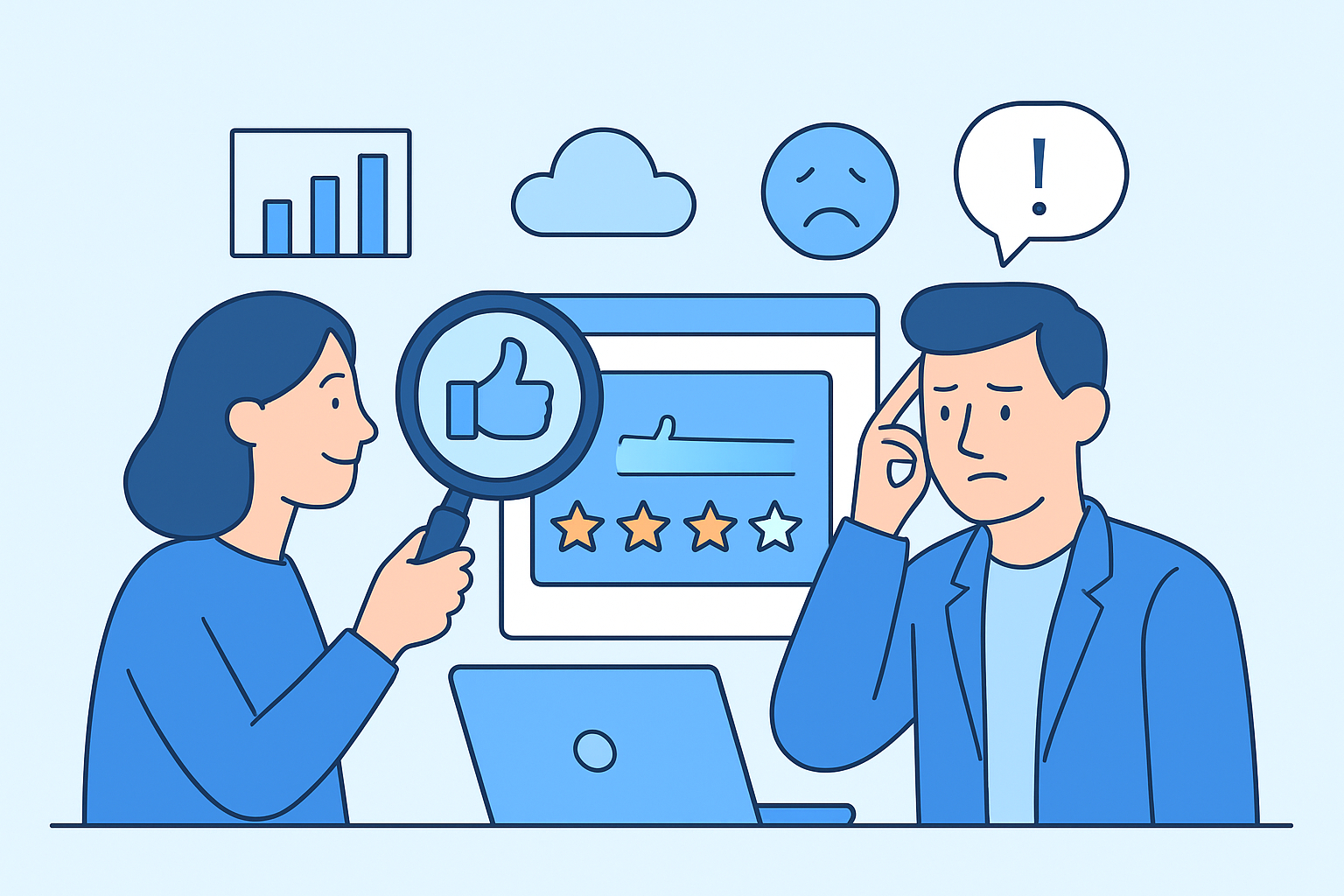
SaaS companies live and die by a handful of review sites, a churn curve, and a support queue that never really closes – which makes reputation management for SaaS companies a fundamentally different discipline than reputation management for a retail brand or a local business. Where a restaurant worries about one bad Friday night, a SaaS company worries about a single G2 review costing it a spot in next quarter’s shortlist, or a status page outage turning into a Twitter thread before the incident is even resolved internally.
This article breaks down what actually makes SaaS reputation different, where most teams get caught off guard, and how to build a monitoring approach that matches the way software buyers actually make decisions.
Why SaaS reputation behaves differently than other industries
Consumer brands mostly deal with reputation damage that’s emotional and fast – a viral complaint, a product recall, a PR mess. SaaS reputation damage is usually slower and more procedural, but it hits harder financially because of how B2B buyers research.
A prospect evaluating a $30,000 annual contract doesn’t just glance at a star rating. They read the last ten reviews on G2 or Capterra, check how support tickets get resolved, look at whether the product roadmap keeps promises, and often ask peers in a Slack community or LinkedIn group. That means a SaaS company’s reputation isn’t one score – it’s a paper trail spread across review platforms, community forums, release notes, and support interactions, all of which a serious buyer will cross-reference before signing anything.
The myth worth busting here: many SaaS founders assume that because they don’t sell to consumers, they’re insulated from the kind of reputation monitoring that retail brands need. The opposite is true. B2B buying cycles are longer and more research-heavy, which means there’s more time and more surface area for a competitor, a disgruntled ex-customer, or a bad release to shape the narrative before a deal ever reaches a sales call.
The unique pressure points in SaaS reputation management
A few areas cause more damage in SaaS than in almost any other business model:
Uptime and status transparency. When a SaaS product goes down, customers don’t wait quietly – they check the status page, and if it’s stale or missing, they assume the worst and post about it. A status page that isn’t updated within minutes of an incident often does more reputational harm than the outage itself.
Review-site concentration. Unlike consumer reviews spread across dozens of platforms, SaaS buyer trust concentrates heavily on G2, Capterra, and TrustRadius. A cluster of unanswered negative reviews on just one of these sites can quietly tank a company’s category ranking, which then affects visibility to new prospects who never even read the reviews themselves.
Churn-driven reviews. Cancelled customers are disproportionately likely to leave a review, and they tend to leave it right after cancelling – meaning the review often reflects the worst moment of the relationship rather than the average experience. Left unmanaged, this skews the public record toward outliers.
Feature-gap complaints. SaaS products evolve constantly, so a review complaining about a missing feature can become outdated within a quarter but still sits at the top of a review page influencing new buyers for years.
Security and compliance scrutiny. Enterprise SaaS buyers now routinely check domain security posture, SSL configuration, and email authentication as part of vendor due diligence – technical trust signals that consumer brands rarely get quizzed on but that can quietly disqualify a SaaS vendor from a shortlist.
Building a monitoring routine that fits a SaaS sales cycle
A practical starting point is mapping monitoring to the buyer journey rather than treating it as a generic brand-watching exercise.
Early-stage awareness: track mentions on LinkedIn, industry forums, and comparison sites, since this is where prospects first form an opinion before they’ve even visited the website.
Evaluation stage: this is where G2 and Capterra reviews carry the most weight, along with any visible support response patterns – buyers specifically look at whether negative reviews get a thoughtful reply or get ignored.
Post-sale stage: monitor support-related mentions, community complaints, and renewal-adjacent sentiment, since this is where churn risk shows up before it hits the CRM.
A common mistake is checking review sites weekly or monthly. In B2B SaaS, a single unanswered one-star review sitting untouched for three weeks during an active evaluation cycle can be the difference between making and missing a shortlist – daily or hourly checks catch this while there’s still time to respond.
Responding to SaaS-specific reputation threats
When a negative review or public complaint appears, the response needs to account for the fact that other prospects are reading it as a proxy for how support will treat them post-purchase. A generic, defensive reply signals exactly the kind of support experience a buyer is trying to avoid.
Practical steps that consistently work: acknowledge the specific issue rather than a templated apology, state what changed or will change, and where possible, follow up publicly once the issue is resolved so future readers see the full arc, not just the complaint. This pattern does more to build B2B trust than any number of five-star reviews, because it demonstrates the support experience directly rather than just claiming it.
Common questions about SaaS reputation management
Does reputation management matter more for SaaS than other business types?
It matters differently rather than more. SaaS buying cycles are longer and more research-driven, so there’s more time for reputation signals to influence a deal, and the concentration of trust on a few review platforms means each individual review carries outsized weight compared to a typical consumer purchase.
How often should a SaaS company check review sites and mentions?
Ideally continuously, or at minimum daily, since active buying cycles can be short and an unanswered negative review during an evaluation window has a real chance of costing a deal that a monthly check would miss entirely.
Should a SaaS company respond to every negative review?
Yes, within a reasonable timeframe. Even reviews that seem unfair or outdated benefit from a public, specific response, because the audience that matters most is the prospect reading it later, not the reviewer themselves.
SaaS reputation management ultimately comes down to recognizing that buyers research differently than consumers do – slower, more thorough, and more willing to dig into support quality, uptime history, and even technical trust signals before committing budget. Building a monitoring habit around how G2 and Capterra reviews influence B2B buying decisions, staying visible through LinkedIn for B2B reputation, and tracking reputation management metrics that actually matter gives a SaaS team a much clearer picture of what prospects see before they ever pick up the phone.